Can I Sell an Inherited Orlando Home From Out of State?
Yes. In many cases, an inherited Orlando home can be prepared, listed, placed under contract, and closed without the seller traveling to Florida. Electronic signatures, video calls, mobile notaries, remote online notarization, and secure closing systems can handle much of the administrative work.
An out-of-state heir, trustee, or personal representative still needs the legal authority to sell, an acceptable title and closing process, and reliable local oversight of the house itself.
This article addresses the real estate and property-coordination side of a remote sale. Questions involving probate authority, trust administration, estate disputes, taxes, or the interpretation of legal documents should be directed to the appropriate Florida attorney or tax professional.
What Parts of an Orlando Home Sale Can Be Completed Remotely?
Most of the communication, marketing, negotiation, and transaction-management work can be completed from another state.
Depending on the estate documents, title requirements, property condition, and closing provider, an out-of-state seller may be able to complete the following without visiting Orlando:
- Initial property consultations by telephone or video
- Interviews with prospective real estate agents
- Pricing and market-position discussions
- Listing documents through electronic signature
- Property-condition reviews through live or recorded video
- Vendor estimates and approvals
- Offer review and contract negotiations
- Inspection-response decisions
- Title-document delivery
- Seller disclosures and affidavits
- Closing-document execution
- Delivery of proceeds through an approved payment method
Florida law provides a framework for remote online notarization and the remote witnessing of qualifying electronic records. That does not mean every closing document will automatically be handled online. The title or closing company must confirm which documents it will accept, how identity will be verified, and whether witnesses, a mobile notary, original documents, or overnight delivery will be required.
Remote does not mean automatic. Probate orders, trust provisions, death certificates, prior liens, multiple heirs, marital interests, foreign sellers, and questions about signing authority can all affect the process.
What Still Requires Someone in Orlando?
A house cannot conduct its own condition check, meet a locksmith, notice a leaking water heater, or explain why the air conditioning stopped working in July.
Someone local may need to handle or coordinate:
- Retrieving or replacing keys
- Confirming that doors and windows are secure
- Checking utilities and major systems
- Observing signs of leaks, pests, vandalism, or storm damage
- Meeting contractors, cleaners, and cleanout crews
- Providing access to inspectors and appraisers
- Checking work after a vendor reports completion
- Monitoring landscaping, pool service, and exterior appearance
- Removing mail, notices, and packages
- Confirming that the property remains ready for showings
- Reviewing the property before closing
A real estate agent is not automatically a property manager, general contractor, insurance adjuster, probate attorney, or professional home inspector.
The agent’s role should be clearly defined: observe, document, communicate, facilitate access, coordinate seller-approved vendors, and help the seller evaluate the property’s real estate options.
Secure the Property Before You Focus on Selling It
Before discussing paint colors, staging, or photography, confirm that the home is physically secure.
- Determine who currently has keys, remotes, gate credentials, and alarm codes.
- Change or rekey exterior locks when access is uncertain.
- Secure sliding doors, garage doors, sheds, fences, and side gates.
- Confirm which utilities are active and which need to remain active.
- Look for visible water intrusion, roof damage, plumbing problems, or pest activity.
- Document the home’s starting condition with photographs and video.
- Remove obvious valuables, medications, financial records, and identity documents.
- Establish who will check the property and how reports will be delivered.
Orlando’s heat, humidity, heavy rain, tropical weather, pools, landscaping, and pest activity can turn a small maintenance issue into a much larger one when a vacant house goes unchecked.
Confirm Insurance Coverage for a Vacant or Unoccupied Home
The seller or authorized estate representative should contact the property’s insurance agent promptly.
A home that is vacant, temporarily unoccupied, or no longer owner-occupied may not be treated the same way under the existing homeowners policy. Coverage terms, exclusions, inspection requirements, notice requirements, and vacancy provisions vary by policy and carrier.
The insurance professional should be told about:
- The owner’s death
- The current occupancy status
- Who is legally responsible for the property
- Whether utilities remain active
- Whether repairs or renovations are planned
- How frequently the property will be checked
The real estate agent can identify visible concerns and help facilitate access, but the insurance carrier—not the Realtor—determines whether coverage remains sufficient.
Establish a Video Walkthrough and Reporting Standard
“Everything looks fine” is not a useful reporting system.
An out-of-state seller should receive enough visual information to understand the property’s condition and make decisions without relying on vague descriptions.
A useful initial walkthrough should normally show:
- The street and immediate surroundings
- The front, sides, and rear exterior
- The visible roofline
- Landscaping and drainage conditions
- Entry points and locks
- Every interior room
- Ceilings, walls, and flooring
- The kitchen and bathrooms
- The electrical panel
- The water heater and HVAC equipment
- The garage, sheds, and accessible storage areas
- The pool and pool equipment when applicable
- Personal property remaining in the home
- Visible damage or deferred maintenance
Significant concerns should also be documented with still photographs. Video provides context, while close photographs make it easier to compare estimates, track changes, and show exactly what a vendor was asked to address.
Use Before-and-After Reporting for Approved Work
For each meaningful project, the seller should be able to answer:
- What condition was observed?
- What work was proposed?
- What did the seller authorize?
- Which vendor performed it?
- What did it cost?
- Was the result visually reviewed?
- Does the seller need to make another decision?
The goal is not to produce a home-renovation television series. It is to create an understandable record of what was found, what was approved, and what happened next.
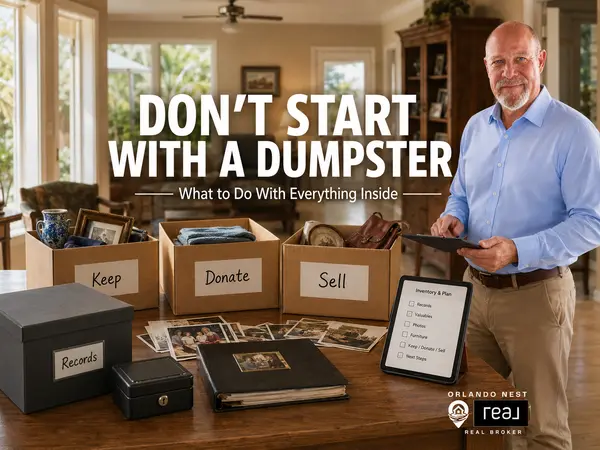
Create a Separate Plan for Personal Property and Cleanout
Inherited homes often contain furniture, photographs, legal documents, collectibles, clothing, tools, vehicles, family keepsakes, and decades of ordinary household belongings.
The seller should determine what happens to those contents before authorizing a general cleanout.
- Identify items that heirs or beneficiaries wish to keep.
- Separate legal, tax, military, financial, and family records.
- Arrange shipping or storage for retained property.
- Determine whether valuable items require an appraiser or estate-sale company.
- Donate suitable household goods.
- Remove trash, hazardous materials, and unwanted contents.
- Document the empty or partially cleared home afterward.
The Realtor can help identify local vendors and coordinate approved access, but the seller or legally authorized representative should decide what may be sold, donated, discarded, shipped, or transferred.
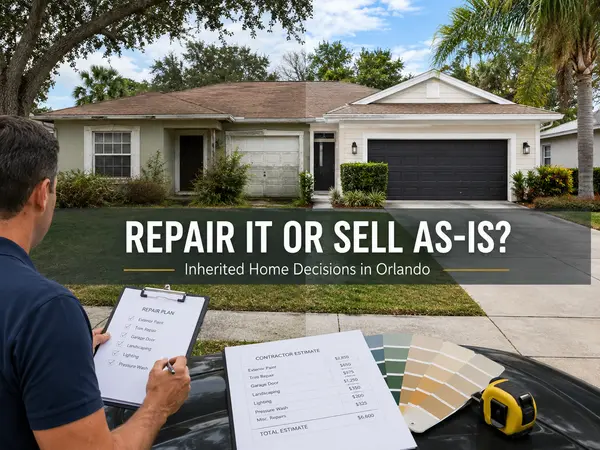
Decide How Much Work the Home Really Needs
Once the property is secure and its contents are understood, the seller can decide how it should be positioned for the Orlando market.
| Strategy | What it involves | Potential advantage | Primary risk |
|---|---|---|---|
| Sell in current condition | Market the home with its existing repairs, contents, or deferred maintenance clearly addressed | Faster preparation and fewer estate-funded expenses | Smaller buyer pool or larger condition discount |
| Clean and stabilize | Remove debris, deep clean, correct active leaks, secure the home, and improve basic presentation | Can reduce buyer uncertainty without undertaking a renovation | May not address larger condition objections |
| Complete selective repairs | Address specific items that may materially expand the buyer pool | Can improve marketability without rebuilding the house | Costs and timelines can grow without disciplined scope |
| Complete a larger renovation | Update major finishes, systems, or multiple rooms before listing | May support a higher price or broader retail positioning | Contractor, permit, carrying-cost, and market-timing risk |
The right decision should be based on expected net proceeds—not merely the highest possible asking price.
For a more detailed comparison, read Should You Repair an Inherited Home or Sell It As-Is in Orlando?
Control Showing, Inspection, and Appraisal Access
Once the home is listed, access should be controlled through an agreed system rather than a loose collection of spare keys.
A remote-sale access plan may include:
- A professional electronic lockbox
- Written showing instructions
- Records of agent access
- Alarm and gate procedures
- Vendor appointments through a designated local contact
- Access for photographers and measurement providers
- Buyer inspection and reinspections
- Appraiser access
- Repair-estimate access
- A final walkthrough and pre-closing property review
The seller should also receive regular reporting on showing activity, buyer feedback, property condition, new maintenance concerns, market response, and any recommended change in presentation or price.
A vacant property should not become invisible between showings. Its physical condition still needs attention until possession transfers to the buyer.
Start Title Review Early
The closing company should be involved early when a property has been inherited.
Depending on how the property was owned, the title company or attorney may need to review:
- The current deed and public-record ownership
- The deceased owner’s death certificate
- Probate filings and court orders
- Letters of administration
- Trust documents or certificates of trust
- The identity and authority of the proposed signer
- Existing mortgages, liens, judgments, or unpaid assessments
- Marital or homestead questions
- Prior deeds or ownership discrepancies
- Requirements affecting multiple heirs or beneficiaries
A real estate agent can help keep the appropriate parties connected, but the title company and attorneys determine whether the seller has authority to convey title and what must be completed before closing.
The broader guide, Selling an Inherited or Trust Home in Orlando , explains the wider relationship among authority, title, probate, taxes, property preparation, and the sale.
Sellers who need to document an inherited property’s historical value may also find Date-of-Death Appraisal vs. Current Appraisal for an Inherited Florida Home helpful when discussing basis and estate records with their attorney, accountant, or appraiser.
How Remote Title and Closing May Work
Florida permits remote online notarization, and an online notary may supervise the witnessing of qualifying electronic records through approved audio-video technology.
Florida deeds generally require execution in the presence of two subscribing witnesses. The title company should therefore confirm how the deed and any other recordable documents will be signed, witnessed, notarized, returned, and recorded.
Depending on the provider and transaction, the closing may use:
- A secure remote online notarization platform
- A mobile notary near the seller
- An attorney or other approved notary
- Overnight delivery of original documents
- A hybrid process combining electronic and original signatures
Do not assume every document can be signed with the same electronic-signature platform used for the listing agreement. Confirm the procedure early enough to resolve identity verification, witness availability, technology requirements, and delivery deadlines.
For more general information about choosing and evaluating the professional overseeing the sale, see What to Ask When Interviewing an Orlando REALTOR® .
Protect the Sale Proceeds From Wire Fraud
Out-of-state sellers should be especially cautious when providing instructions for the disbursement of sale proceeds.
Criminals may impersonate title companies, attorneys, real estate agents, buyers, sellers, or bank employees. A fraudulent message may use a nearly identical email address, copied signature block, stolen transaction details, or urgent instructions to change an account.
- Obtain the closing company’s verified telephone number early.
- Ask how wiring and payoff instructions will be delivered.
- Do not trust a last-minute banking change sent only by email.
- Call a known number before providing or changing instructions.
- Do not use a telephone number contained in a suspicious message.
- Inspect the complete email address and domain carefully.
- Be skeptical of urgency, secrecy, pressure, or unusual wording.
- Confirm the receiving account name and financial institution.
- Ask the closing company to explain its identity-verification process.
- Contact the financial institution and closing company immediately if anything appears wrong.
The FBI’s Internet Crime Complaint Center warns that business-email-compromise schemes target every participant in a real estate transaction, including buyers, sellers, real estate agents, attorneys, and title companies.
Review the FBI’s current guidance on business email compromise and fraudulent transfers .
Remote Inherited-Home Sale Checklist
Authority and Title
- Confirm who has legal authority to sell.
- Locate the relevant trust, probate, and estate documents.
- Engage Florida legal counsel when needed.
- Have the closing company review ownership and signing requirements early.
Property Security
- Account for keys, remotes, gate credentials, and alarm codes.
- Change locks when access is uncertain.
- Check doors, windows, garage entries, gates, and exterior structures.
- Create an initial visual condition record.
Insurance and Utilities
- Notify the insurer about the owner’s death and occupancy change.
- Confirm coverage for a vacant or unoccupied home.
- Maintain required electrical, water, HVAC, pool, and landscape service.
- Create a hurricane and severe-weather inspection plan.
Contents and Condition
- Identify property the family wants to retain.
- Remove financial records, medications, valuables, and identity documents.
- Obtain cleanout, estate-sale, repair, or maintenance proposals as needed.
- Choose an as-is, stabilization, selective-repair, or renovation strategy.
Listing and Transaction
- Establish video and photographic reporting expectations.
- Approve showing and vendor-access procedures.
- Review offers and disclosures through secure systems.
- Maintain regular property and transaction updates.
- Confirm inspection, appraisal, and repair access.
Closing and Proceeds
- Confirm the approved signing method.
- Arrange notarization and witnesses in advance.
- Verify banking instructions through a trusted second channel.
- Reject unexplained last-minute wire changes.
- Review the expected settlement statement and proceeds.
Ted’s Take: Remote Selling Is a Communication Test
Selling from another state can work extremely well when the local process is organized.
The seller should always know:
- Who is responsible for each task
- What has been observed at the property
- Which decisions remain unresolved
- What work has been approved
- What the next deadline is
- When the property’s condition or transaction status changes
A seller should not need to chase five vendors and three transaction professionals to find out whether the back door was locked.
My role is to create one understandable real estate process around the property: evaluate its market position, document what I can observe, coordinate approved access, communicate with the transaction team, and keep the seller informed.
When legal, tax, insurance, construction, appraisal, or specialized property issues arise, I help identify the question and get it in front of the appropriate professional. That is considerably more useful than pretending one person should be the expert in everything.
Frequently Asked Questions
Do I have to travel to Orlando to list an inherited house?
Usually not. Listing documents, pricing discussions, offer negotiations, property updates, and many closing documents can often be handled remotely. Local property access and oversight will still need to be arranged.
Can I sign the closing documents online?
Possibly. Florida permits remote online notarization, but the closing company must determine whether remote signing is appropriate for the documents in the transaction. Some closings instead use a mobile notary, overnight documents, or a combination of signing methods.
Who checks the house while I am out of state?
The responsibility should be agreed upon before listing. A local Realtor may conduct documented property reviews and coordinate access, but ongoing property-management, construction, insurance, or inspection duties may require additional professionals.
Can my Realtor coordinate contractors and cleanout companies?
A Realtor can help identify vendors, obtain proposals, facilitate approved access, and report observable results. The seller or authorized estate representative should approve the scope, contracts, costs, and disposition of personal property.
What happens if several heirs live in different states?
The sale may still be handled remotely, but the closing company and estate attorney must determine who has authority to sign and whether additional consents, probate steps, or documents are required. Address those questions before accepting an offer whenever possible.
Can the sale proceeds be wired to my bank?
Often, yes, subject to the closing company’s policies and identity-verification procedures. Confirm all banking instructions directly using a known telephone number, and never rely solely on an emailed request to change an account.
Start With a Remote Orlando Property Review
An inherited Orlando home does not have to become a second job in another state.
The first step is to establish what the property looks like now, what needs immediate attention, who has authority to make decisions, and which sale strategy makes financial sense.
Ted Moseley is a Central Florida REALTOR® with Orlando Nest and Real Broker, LLC, serving Orlando and surrounding communities throughout Orange, Seminole, Osceola, Polk, Lake, and Volusia counties.
Categories
Recent Posts




STAY UP TO DATE WITH THE MARKET