
Selling a Home as Tenants in Common in Orlando
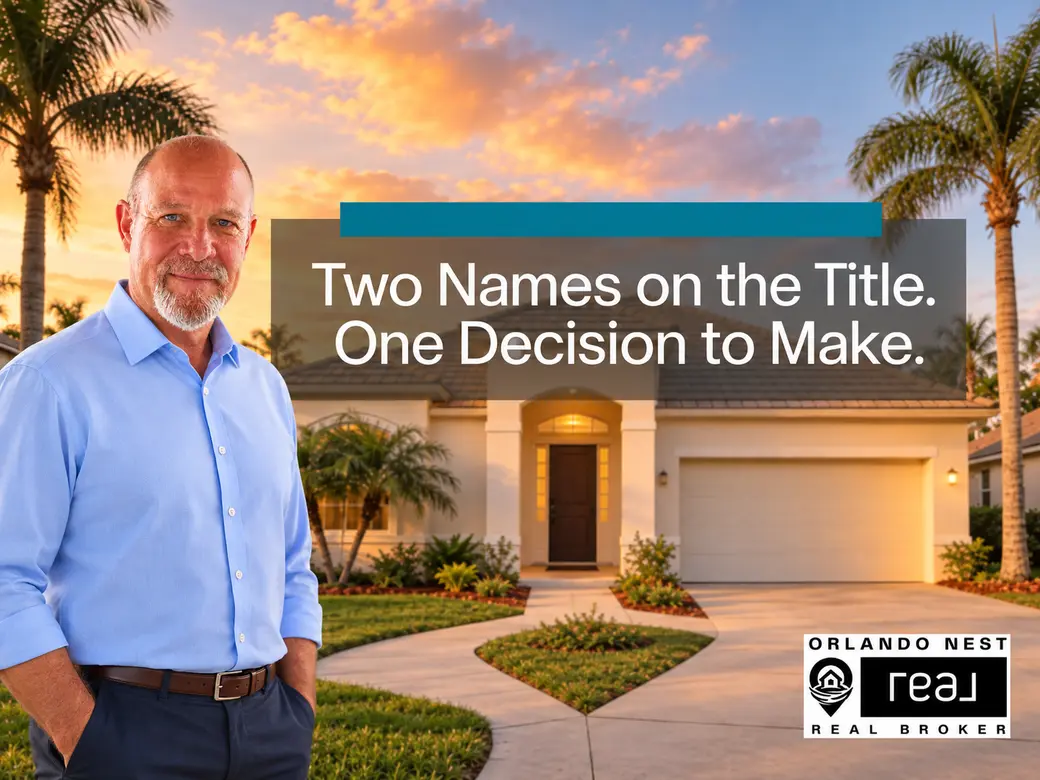
Selling a home owned as tenants in common can be straightforward when both owners agree on what should happen. When they don't, the real estate problem can quickly become a legal one.
For unmarried co-owners in Orlando, the practical choices are usually some combination of a voluntary sale, one owner buying out the other, negotiation or mediation, or, when agreement becomes impossible, speaking with a Florida real estate attorney about partition.
Quick Summary
If two people own an Orlando-area property together as tenants in common:
- Each owns an interest in the property
- One owner generally cannot voluntarily sell the entire property without dealing with the other owner's interest
- One owner may be able to buy out the other
- A voluntary sale is usually much simpler and less expensive than litigation
- If co-owners cannot agree, Florida law allows a tenant in common to seek partition through the courts
- Ownership percentages, mortgage responsibility and the eventual division of proceeds are related issues, but they are not always as simple as “50/50”
The earlier both owners establish how decisions will be made, the easier the eventual sale tends to be.
What Does “Tenants in Common” Mean in Florida?
Florida law generally provides that when property is conveyed to two or more people, it creates a tenancy in common unless the deed expressly provides for a right of survivorship or another form of ownership applies.
That matters because tenants in common do not automatically have survivorship rights.
If one owner dies, that owner's interest does not necessarily pass automatically to the other co-owner. Estate planning, the deed and other legal considerations can determine what happens next.
The ownership interests also do not necessarily have to be equal.
Two people might own a home 50/50, but other ownership percentages are possible depending on how title was taken.
If you are not sure how your property is titled, don't guess from who is on the mortgage or who contributed the down payment. Start with the recorded deed and, if necessary, have a title professional or Florida real estate attorney explain what it says.
Florida Statute 689.15 explains the state's treatment of survivorship and tenancy in common.
The Sunny-Day Version: Both Owners Agree to Sell
This is the version everyone hopes for.
The relationship may have changed, but both owners agree that selling the home is the sensible financial decision.
Once that agreement exists, the real estate process can look much like an ordinary sale:
- Establish current market value
- Agree on a pricing strategy
- Decide what preparation or repairs make sense
- Put the home on the market
- Review offers
- Negotiate inspection and other contract issues
- Close the transaction
The extra challenge is that there are two owners whose decisions need to stay aligned.
That is why I like to address several things before the property ever hits the market.
Agree on Pricing Expectations
What does the market support?
What list price are both owners comfortable with?
More importantly, what happens if the market tells us the original price is too high?
Agreeing to list a property is easy.
Agreeing to a price reduction after three weeks of weak showing activity can be harder.
Agree on How Offers Will Be Evaluated
Is the goal simply the highest possible price?
Does one owner need a faster closing?
Would either owner consider seller concessions?
How will repair requests be handled?
Those conversations are much easier before an actual buyer is waiting for an answer.
Keep Communication Transparent
In a sensitive co-owner transaction, I do not want one party wondering what I told the other.
Important listing activity, feedback, offers and negotiations should be handled with both owners appropriately informed.
The real estate agent's job is to sell the property, not become a referee in the relationship.
The Cloudy-Day Version: One Owner Wants to Sell and the Other Doesn't
This is where things become more difficult.
One owner may want to sell because they need their equity.
The other may want to remain in the property.
One may believe the home is worth considerably more than the market supports.
Or communication may simply have broken down.
At that point, the first goal should usually be to determine whether there is still a voluntary solution.
Litigation exists for a reason.
That doesn't mean it should be Plan A.
Option 1: Reach a Voluntary Sale Agreement
Sometimes the disagreement is narrower than it initially appears.
One owner may not oppose selling. They may oppose:
- The proposed price
- The timing
- Moving immediately
- Paying for repairs
- How proceeds are expected to be divided
- Which agent should handle the sale
- Feeling as though the other owner is making all the decisions
If those underlying issues can be identified, the owners may still be able to create a workable sale plan.
That could involve attorneys, mediation or simply clearer written expectations between the parties.
The advantage is control.
A voluntary sale allows the owners to decide when to list, how to prepare the property, what offer to accept and how to manage the transaction.
Once a court becomes involved, some of that control may disappear.
Option 2: One Owner Buys Out the Other
A sale to a third-party buyer is not the only way to separate two owners financially.
If one owner wants to keep the home, a buyout may be possible.
Conceptually, the process involves three questions.
What Is the Property Worth?
The owners need an agreed method of establishing value.
That might involve an appraisal, a market analysis, an agreed valuation professional or another method recommended by their advisers.
What Is Each Owner's Economic Interest?
This can be more complicated than multiplying the estimated equity by 50%.
Ownership percentages matter, but so can mortgages, liens, documented agreements between the owners, credits, reimbursements and other financial or legal issues.
If the parties disagree about that calculation, that is a matter for their attorneys or other appropriate professionals, not the real estate agent to adjudicate.
Can the Remaining Owner Actually Afford the Home?
This is often the deciding question.
If both owners are obligated on the existing mortgage, simply signing a deed does not ordinarily remove one borrower from the loan.
The person keeping the property may need to refinance, qualify independently or pursue another lender-approved solution.
A buyout that solves the deed but leaves both people tied to the debt has not necessarily solved the problem.
The Mortgage and the Deed Are Different Things
This is one of the biggest sources of confusion in co-owner situations.
Title tells us who owns the property.
The mortgage and note tell us who is obligated on the loan.
Those are not the same document.
Someone can have an ownership interest without being a borrower on the mortgage.
Someone may also remain responsible for a mortgage even after their relationship with the other owner has ended.
So before deciding that one person will “just take over the house,” find out:
- Who is actually on the deed?
- Who signed the note and mortgage?
- What is the current loan balance?
- Is the loan assumable?
- Can the remaining owner qualify for a refinance?
- What other liens affect the property?
Those facts determine whether a buyout is practical.
Option 3: Consider Mediation or Attorney-Assisted Negotiation
Sometimes the owners are too far apart to work it out directly but not so far apart that a lawsuit is inevitable.
That is where a neutral process can help.
A mediator does not decide who wins.
The objective is to help the parties reach their own agreement.
Likewise, an attorney may be able to clarify what each owner can realistically expect if the dispute escalates.
That information can change negotiations rather quickly.
The question often becomes:
Would we rather control the sale ourselves, or spend money asking a court to resolve something we might still be able to resolve voluntarily?
That is a decision for the owners and their attorneys.
From the real estate side, a negotiated voluntary sale is usually much easier to execute because everyone knows who has authority to make decisions.
Option 4: Partition
If the owners cannot agree, Florida law provides a legal process called partition.
Florida Statute Chapter 64 allows one or more tenants in common or joint tenants to bring an action involving co-owned real property.
For a typical single-family home, physically dividing the property into separate usable pieces is often impractical. Depending on the property and applicable law, a court may ultimately order a sale rather than physical division.
But partition law contains procedures, rights and potential financial consequences that depend heavily on the facts.
That is where my role stops.
If a co-owner is seriously considering forcing a sale, or has received a demand or lawsuit from another owner, they should speak with a Florida attorney who handles real-property disputes.
Florida Statute Chapter 64 contains the state's partition provisions.
Partition Can Be More Complicated Than “Force the House to Be Sold”
This is another place where I would be careful with internet advice.
Florida's Chapter 64 contains rules governing parties, interests, judgments, sales, costs and attorney fees.
Florida also has a Uniform Partition of Heirs Property Act that may apply when property qualifies as heirs property. That law contains additional procedures dealing with valuation, cotenant rights and whether property should be divided or sold.
So the phrase “I'll just file partition and force a sale” skips quite a few steps.
For an ordinary consumer trying to solve a co-owner dispute, the useful takeaway is simpler:
Partition exists, but once you reach that point you need legal advice specific to your ownership and property.
What Happens to the Sale Proceeds?
In a simple voluntary sale where everyone agrees, the owners can work with the title company and their advisers to establish how the closing proceeds will be disbursed after mortgages, liens, closing expenses and other obligations are satisfied.
But co-owner disputes can make the final division more complicated.
For example, one owner may claim that they:
- Paid a larger share of the down payment
- Paid the mortgage alone for a period
- Paid taxes or insurance
- Funded substantial repairs
- Made improvements to the property
- Are owed money under a separate agreement
Whether any of those claims changes the final economic division is a legal question.
This is why I would not wait until closing day to discover that the two owners have completely different ideas about who gets what.
If proceeds are disputed, resolve the issue with the appropriate attorneys and title professionals before the transaction reaches the closing table.
For a separate breakdown of the ordinary costs that can come out of a Florida seller's proceeds, see What Are Closing Costs for Sellers in Florida?.
What If One Owner Has Moved Out?
Moving out does not by itself erase someone's ownership interest or loan obligation.
One owner may live elsewhere while still:
- Remaining on title
- Remaining responsible for the mortgage
- Being responsible for agreed property expenses
- Having an interest in the eventual proceeds
It can also create practical issues.
Who maintains the property?
Who pays utilities?
Who keeps the property ready for showings?
Who approves repairs?
Who has access?
These are mundane questions until nobody has agreed on the answers.
Then they become transaction problems.
What If One Owner Stops Paying the Mortgage?
If both borrowers are obligated on the mortgage, a missed payment can affect both borrowers regardless of which person was supposed to make the payment under a private arrangement.
That is one reason financially distressed co-owner situations should be addressed quickly.
A disagreement between owners does not stop the mortgage servicer, HOA, insurer or tax collector from expecting payment.
If the property can be sold voluntarily before missed payments, liens or deferred maintenance create additional problems, the owners usually preserve more options.
What If the Owners Disagree About the List Price?
This happens frequently.
One owner may be ready to move on.
The other may believe accepting market value somehow means losing the breakup.
The house doesn't know about the relationship.
Buyers certainly don't.
The property will be judged against competing homes and recent sales.
My role in that situation is to provide the same market evidence to both owners:
- Comparable closed sales
- Current competition
- Price-per-square-foot context where useful
- Property condition
- Days on market
- Price reductions
- Buyer feedback
- Showing activity
The objective is not to decide which owner is right.
It is to establish what the market is telling us.
How I Would Approach a Cooperative Co-Owner Sale
If both owners called me today and said, “We know the house needs to be sold, but this situation is complicated,” I would start with the real-estate questions.
1. Confirm Who Owns the Property
Get the deed and identify the title holders.
2. Establish Current Market Value
Before discussing who gets what, determine what buyers are realistically likely to pay.
3. Identify Transaction Constraints
Mortgage payoff, property condition, occupancy, HOA requirements, timing and other sale-related issues all matter.
4. Establish a Communication Process
Decide how showing feedback, offers and decisions will be communicated to both owners.
5. Keep Legal Disputes With the Lawyers
If the owners disagree about ownership rights, reimbursement, proceeds or whether someone can force a sale, those questions need legal advice.
6. Keep the Real Estate Transaction Moving
Once the owners have agreement and authority to sell, my job is pricing, preparation, marketing, negotiation and closing coordination.
Keeping those roles separate usually helps everyone.
Ted's Take
Co-owner sales aren't automatically difficult.
The difficult ones are the situations where nobody establishes the rules until the first disagreement shows up.
If both owners agree the home should be sold, we can usually create a process that keeps everyone informed and keeps the transaction professional even if the relationship between the owners is no longer particularly friendly.
Where I become much more cautious is when one person wants me to decide what is “fair” between the two owners.
That's not my job.
I can tell you what I believe the house will sell for.
I can explain what buyers are doing in the market.
I can show you the likely transaction costs and help execute the sale.
I can't decide who deserves more of the equity or tell one owner what legal rights they have against the other.
Knowing where the real estate advice ends is part of handling these transactions well.
Frequently Asked Questions
Can one co-owner force the sale of a jointly owned home in Florida?
Florida law allows a tenant in common or joint tenant to bring a partition action involving co-owned real property. What happens after filing depends on the ownership, property and applicable partition procedures. Anyone considering this route should obtain advice from a Florida real estate attorney.
Do both owners have to agree to sell a home voluntarily?
A normal voluntary sale has to address the ownership interests of everyone whose interest must be conveyed at closing. If one co-owner refuses to cooperate, the other owner should obtain legal advice about options rather than assuming they can simply sell the entire property without them.
Can one owner buy out the other instead of selling?
Potentially, yes. The owners need a method for establishing value and the buyout amount, and the person keeping the home must also resolve any existing mortgage obligations. If both parties are borrowers, transferring title alone generally does not remove one person from the loan.
How are proceeds divided when tenants in common sell?
In an uncomplicated voluntary sale, disbursement can be handled according to the owners' agreed instructions and applicable ownership interests after liens and transaction expenses are paid. If the owners dispute contributions, reimbursements or entitlement to proceeds, attorneys or a court may need to resolve those issues.
What if one co-owner has paid more of the mortgage than the other?
That may matter between the owners, but it does not automatically tell a real estate agent or title company how the final proceeds should be divided. Document the payments and discuss the issue with the appropriate legal and tax professionals before closing.
What happens if one owner stops paying the mortgage?
If both people are borrowers, missed payments can affect both borrowers' credit even if one person was privately responsible for making the payment. Mortgage obligations continue until the lender is paid, refinanced or otherwise agrees to a change.
Are there tax consequences when co-owners sell a home?
Possibly. Federal home-sale exclusion rules generally involve ownership and use tests, and each owner's situation can differ. Co-owners should have a tax professional evaluate their individual circumstances before assuming how much gain will be excluded.
The Bottom Line
Selling a home as tenants in common is easiest when the owners can separate two questions:
What should happen to the house?
and
What financial or legal issues exist between us?
A real estate agent can help answer the first question by establishing value, creating a sale strategy and managing the transaction.
Attorneys, lenders, title professionals and tax advisers may need to answer parts of the second.
When everyone understands those roles, even a difficult co-owner situation has a better chance of becoming a manageable real-estate transaction.
Ted Moseley is an Orlando REALTOR® with Orlando Nest and Real Broker, LLC, helping Central Florida homeowners work through complicated property sales with clear market information and a defined transaction process.
Have You and a Co-Owner Agreed That the Property Needs to Be Sold?
I can help you establish current market value, understand the real-estate side of the transaction and build a sale process that keeps both owners informed.
Categories
Recent Posts





STAY UP TO DATE WITH THE MARKET