
Is College Park a Good Place to Downsize in Orlando?
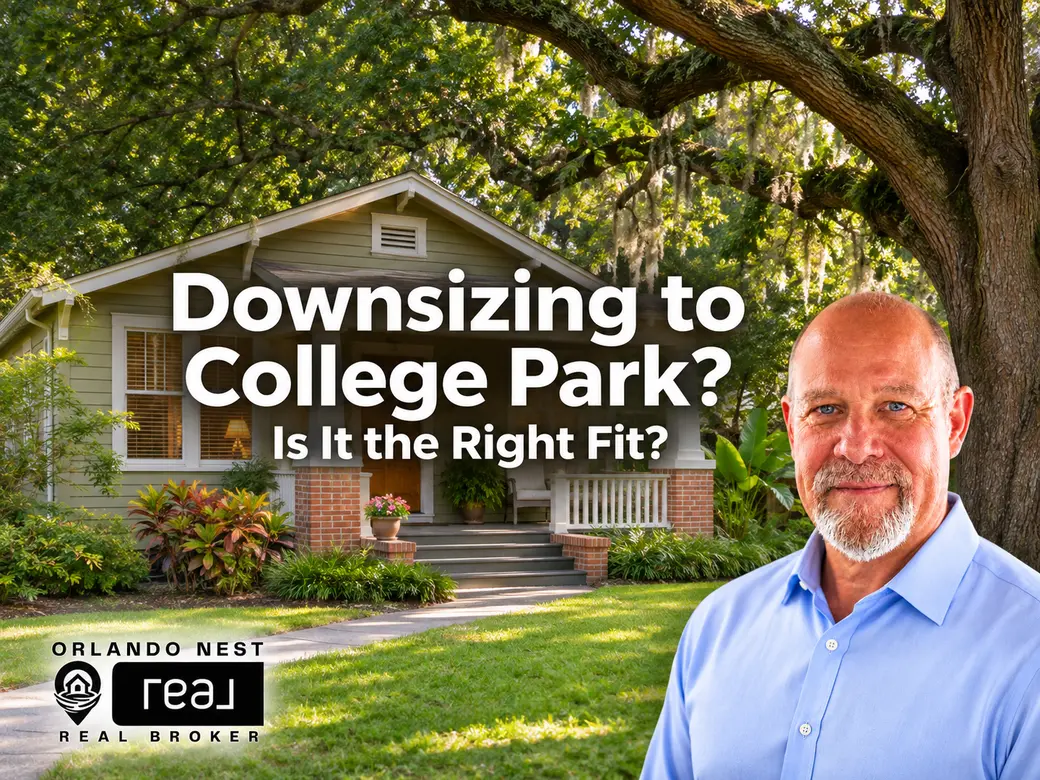
Yes! College Park can be one of Orlando’s better choices for downsizing if your goal is to own less house without giving up restaurants, parks, local businesses and convenient access to Downtown Orlando.
The tradeoff is that “smaller” does not necessarily mean inexpensive or maintenance-free here. College Park is an established neighborhood with older homes, renovated bungalows, condos, townhomes, infill construction and larger properties mixed together. The right downsizing move depends much more on the individual home and the life you want afterward than on square footage alone.
Why College Park Works Differently for Downsizers
A lot of downsizing advice begins with the house. I think that is backwards.
Before deciding whether you need 1,400 square feet instead of 2,800, ask what you want everyday life to look like after the move.
Do you want restaurants and coffee shops nearby? Do you want established streets instead of a new subdivision? Would you rather live close to Downtown Orlando, Winter Park and important everyday destinations than have another bedroom you rarely use?
If those tradeoffs sound familiar, College Park deserves a closer look.
The neighborhood sits just north of Downtown Orlando and is centered largely around Edgewater Drive. The City of Orlando describes it as an established community combining bungalow-style homes, brick and tree-lined streets, parks, lakes and a locally oriented commercial district.
That combination is what makes College Park interesting for downsizing. You can reduce the amount of house you maintain without necessarily reducing the number of things available outside your front door.
Downsizing Is About Reducing Work, Not Winning a Square-Footage Contest
One mistake in conversations about downsizing is treating the smallest possible home as the goal. It isn’t.
A 1,100-square-foot house that needs a roof, extensive landscaping, electrical updating and constant repairs may create more work than a well-designed 1,600-square-foot property.
Likewise, a condo can eliminate yard work while introducing association fees, assessments, elevator dependence, parking considerations and shared-building insurance issues.
The better question is: What parts of homeownership are you trying to get rid of?
For some homeowners, it is the lawn and pool. For others, it is stairs, unused bedrooms or a large property that consumes every weekend. And for some, the real objective is geographic: they want to spend less time driving and more time living in the neighborhood around them.
That last group is where College Park can become particularly attractive.
What Housing Can You Find in College Park?
College Park is not a uniform subdivision, and that is both an advantage and a complication.
Its housing stock includes older bungalows and cottages, mid-century homes, renovated properties, larger custom and infill homes, townhomes, condos and some multifamily options. Inventory and property type availability change, so no category should be treated as guaranteed.
That creates opportunities to rightsize without automatically leaving an established neighborhood. It also means two homes that look similar on a listing website may have very different ownership implications.
An older bungalow might have exactly the charm and manageable footprint you want, but roof age, plumbing, electrical systems, windows, HVAC equipment and insurance eligibility deserve careful attention.
A renovated home may reduce some of those concerns, but the quality and permitting of the renovation matter. A condo or townhome may reduce exterior maintenance, but association reserves, insurance, assessments, rules and monthly fees become part of the financial picture.
There is no universally best choice. The point is to reduce the burdens you actually want to remove.
| If your priority is… | Look closely at… | Watch for… |
|---|---|---|
| Less yard and exterior maintenance | Condo or townhome options | HOA/condo fees, reserves, assessments and insurance |
| Character with a smaller footprint | Older bungalow or cottage | Roof, electrical, plumbing, HVAC and renovation history |
| Fewer immediate projects | Renovated resale or newer infill | Renovation quality, permitting and purchase cost |
| Staying connected to the neighborhood | Homes near the Edgewater Drive corridor | Traffic, parking and exact walking distance |
| Long-term usability | Single-story layouts and accessible entries | Steps, narrow bathrooms, storage and modification needs |
The Lifestyle Case for College Park
College Park’s strongest argument is not a particular house. It is location.
Edgewater Drive gives the neighborhood a recognizable commercial spine with local restaurants, services and businesses. Parks and lakes are woven into the surrounding area, while Downtown Orlando and other central-area destinations remain relatively close.
For someone coming from a larger suburban property, that can change daily life in ways a simple price-per-square-foot comparison misses.
You may give up a three-car garage, a huge yard or an extra guest room. In exchange, you may gain a neighborhood where dinner does not always require a twenty-minute drive.
That trade can be worth far more than another 500 square feet. For broader neighborhood comparisons, see the Orlando Neighborhood Guide.
Walkability Is Useful—but Don’t Oversell It
College Park is often described as walkable, but buyers should be precise about what that means.
Living a few blocks from Edgewater Drive is very different from owning a house on the outer edge of the broader College Park area. Your exact address determines how practical it really is to walk to restaurants, services, parks or other destinations.
The City of Orlando is planning improvements to the Edgewater Drive corridor between Lakeview Street and Par Street. The Complete Street project includes wider sidewalks, upgraded pedestrian facilities and accessibility improvements, as well as traffic-calming and streetscape elements.
As described by the City on November 5, 2026, Segment A construction is expected to begin in early 2027. That is a planned schedule, not a completed improvement or a guarantee of timing.
The project does not make every home in College Park car-free, nor should a buyer purchase a property based on a municipal project alone. The practical test is still the specific route between a home and the destinations you expect to use.
College Park Versus a 55+ Community
College Park and a traditional 55+ community solve different problems.
A 55+ community may offer organized activities, clubhouses, pools, lawn care, peer groups and housing designed specifically around lower-maintenance living.
College Park offers something else: a mixed-age established neighborhood where your social life does not have to revolve around the community association.
Neither approach is automatically better. If you want organized amenities, extensive exterior maintenance services and a built-in social calendar, College Park may not deliver what a purpose-built retirement community can.
If you want to remain part of a broader urban neighborhood with restaurants, local businesses and people at different stages of life, College Park may fit considerably better.
The broader choice is covered in Retiring in Orlando: A Practical Guide to Housing, Communities and Downsizing.
The Expense People Sometimes Miss
Downsizing can release equity, but smaller does not automatically mean cheaper.
In an established central Orlando neighborhood, purchase price is only part of the calculation. Property taxes may change following a purchase; homeowners insurance can be affected by the property’s age, roof, wiring and other characteristics; and renovation costs can change the financial picture quickly.
For a condo or townhome, association documents deserve just as much scrutiny as the unit itself. Ask about current fees, budget, reserves, recent and planned assessments, insurance responsibilities, and rules that may affect resale or everyday use.
Compare total ownership cost, not simply the price of the next home against the value of the one you are selling. A lower purchase price paired with substantial near-term repairs may not be the better long-term financial decision.
The cheapest option on closing day can sometimes become the expensive option five years later.
Who Is College Park Probably Best For?
College Park tends to make the most sense for a downsizer who values location over maximum square footage, wants an established Orlando neighborhood, likes having independent restaurants and businesses nearby, and is comfortable evaluating older housing rather than insisting on brand-new construction.
It is worth investigating if you want to stay connected to central Orlando instead of moving farther into the suburbs simply because you need a smaller home.
On the other hand, someone whose top priorities are extensive resort amenities, brand-new construction, gated surroundings or completely outsourced exterior maintenance may find a better fit elsewhere.
That is why I would not begin with, “Is College Park the best neighborhood?” I would begin with, “What do you want the move to make easier?”
Frequently Asked Questions About Downsizing to College Park
Is College Park a good retirement neighborhood in Orlando?
It can be. College Park offers an established mixed-age environment close to Downtown Orlando with restaurants, parks, lakes and local businesses nearby. Buyers looking specifically for age-restricted amenities or highly structured maintenance services may prefer a traditional 55+ community.
Are there smaller homes in College Park?
Yes. College Park’s housing stock includes smaller historic and mid-century homes along with condos, townhomes, renovated properties and newer infill construction. Availability changes constantly, so search by property characteristics rather than assume every part of College Park offers the same options.
Are older College Park homes expensive to maintain?
They can be, but age alone does not tell the whole story. A properly updated older home may be manageable, while one with aging roofing, electrical, plumbing or HVAC systems can require substantial investment. Insurance considerations make pre-purchase due diligence especially important in Florida.
Can I live in College Park without a car?
Do not assume that. Some addresses provide convenient walking access to Edgewater Drive and nearby amenities, while others remain more car-dependent. Test the actual route from any home you are considering rather than relying only on a neighborhood-level walkability score.
Is College Park better than a 55+ community for downsizing?
That depends on what you want from the move. College Park offers an established mixed-age neighborhood and central Orlando lifestyle. A 55+ community may offer more organized amenities, exterior maintenance and age-focused social programming. Choose the option that removes your unwanted burdens without removing what you still enjoy.
Downsizing Should Improve Your Life, Not Just Shrink Your House
College Park can be an excellent downsizing option, but not because every property is small, cheap or maintenance-free.
Its appeal is that the right home can combine a more manageable footprint with an established neighborhood, local businesses, parks and access to the center of Orlando.
If College Park is on your shortlist, explore the current College Park community page and available homes. Then look beyond bedrooms and square footage. Compare condition, maintenance, accessibility, insurance, ownership costs and what your ordinary Tuesday morning would actually look like after the move.
That is the part of downsizing that matters.
Categories
- All Blogs 91
- College Park 1
- Doctor Lifestyle 12
- Downsizing & Rightsizing 1
- Dr. Phillips / Bay Hill 5
- Golf Communities 5
- Lake Nona 4
- Life Changes 7
- Offers & Negotiation 5
- Orlando Home Affordability 1
- Orlando Neighborhoods 31
- Real Estate Market Insights 2
- Relocation 26
- Seller Strategy 19
- Smart Home Buying 50
- Waterford Lakes & Avalon Park 5
- Winter Garden 4
Recent Posts









STAY UP TO DATE WITH THE MARKET