
Date-of-Death Appraisal vs Current Appraisal for an Inherited Florida Home

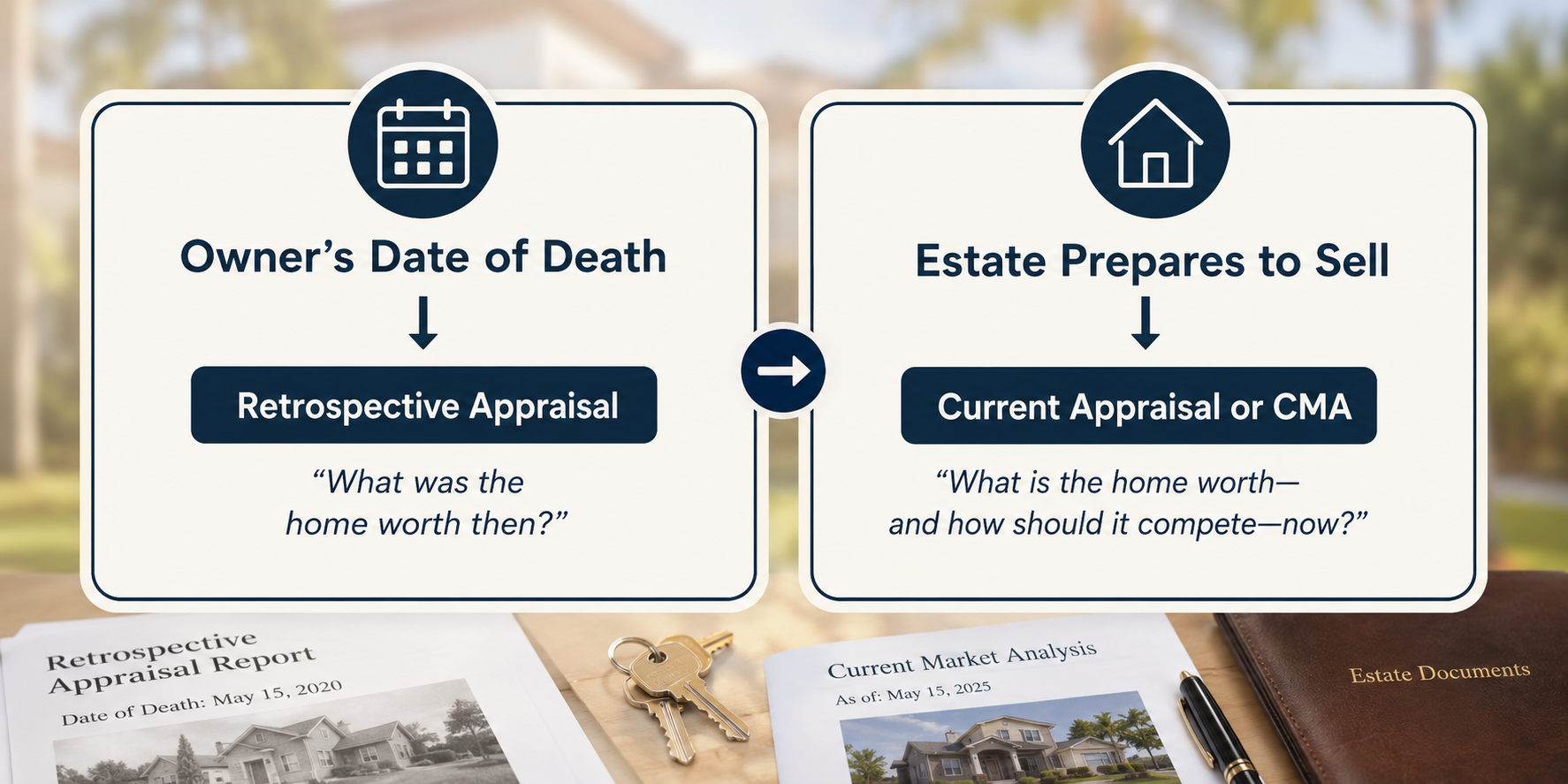
A date-of-death appraisal and a current home valuation answer two different questions. The historical appraisal estimates what an inherited property was worth when the owner died, while a current valuation helps the estate decide what the home may sell for in today’s Central Florida market.
Some estates may need both. Before ordering either one, the personal representative should ask the probate attorney and tax professional what documentation the estate requires.
Quick Summary
- A date-of-death appraisal uses the owner’s date of death as its effective valuation date.
- A current appraisal estimates the property’s value under present market conditions.
- A comparative market analysis prepared by a real estate agent helps establish a listing and marketing strategy but is not the same as an appraisal.
- Florida probate inventories generally include an estimated fair market value for estate property as of the date of death.
- The law does not automatically require a formal real estate appraisal in every estate.
- The probate attorney and CPA should determine what valuation documentation is needed.
What Is a Date-of-Death Appraisal?
A date-of-death appraisal is a retrospective appraisal. It estimates the property’s fair market value as of the date the owner died, even when the appraisal itself is ordered months or years later.
The Key Definition
“Date of death” describes the effective valuation date—not necessarily the date the appraisal is performed.
For example, suppose a homeowner died in August 2024, but the family did not order an appraisal until March 2026. The appraiser would research market conditions and comparable sales relevant to August 2024 rather than valuing the home based on March 2026 conditions.
A date-of-death appraisal may be useful for:
- Supporting the estate inventory
- Establishing or documenting the inherited property’s tax basis
- Dividing estate assets among beneficiaries
- Resolving disagreements about historical value
- Supporting estate or tax filings
- Documenting the value of the property before later repairs or deterioration
The appraiser may review historical comparable sales, the property’s condition at the relevant time, public records, photographs, repair invoices, prior listings, and other available evidence. The farther removed the appraisal is from the date of death, the more important good records may become.
Does Florida Probate Always Require a Formal Appraisal?
Not necessarily.
Florida law generally requires a personal representative to file an inventory identifying estate property and providing its estimated fair market value as of the decedent’s date of death. That requirement does not, by itself, state that every piece of real estate must receive a formal appraisal.
The statutory inventory requirement appears in Florida Statutes Section 733.604 .
A formal retrospective appraisal may nevertheless be advisable when:
- The property represents a substantial portion of the estate
- The value is difficult to estimate
- The home is unusual or lacks reliable comparable sales
- Beneficiaries disagree about its value
- Significant time has passed
- Tax basis documentation is important
- The estate may face increased scrutiny
- The attorney, CPA, court, or another professional requests one
The personal representative should not guess about the required documentation or rely solely on an online home-value estimate. The estate’s probate attorney and tax professional should determine whether a formal appraisal is necessary.
What Is a Current Appraisal?
A current appraisal estimates the property’s value under present market conditions. It may be ordered when the estate is preparing to sell, refinancing a property, completing a beneficiary buyout, or resolving a current value disagreement.
The appraiser typically evaluates:
- Recent comparable sales
- Current property condition
- Location and lot characteristics
- Renovations and deferred maintenance
- Current competition
- Market conditions as of the appraisal’s effective date
A current appraisal does not replace a date-of-death valuation when the estate needs to document the property’s historical value. It answers a different question.
A home may have been worth one amount when the owner died and another amount when the estate is ready to sell. Market appreciation, declining market conditions, repairs, storm damage, vacancy, deferred maintenance, or neighborhood changes can create a meaningful difference between the two.
Is a Comparative Market Analysis the Same as an Appraisal?
No. A comparative market analysis, commonly called a CMA, is prepared by a real estate agent to help determine how a property should be positioned in the current market. It examines comparable sales, active competition, property condition, buyer behavior, and pricing strategy.
A licensed or certified appraiser produces an appraisal as an independent professional opinion of value for a specified purpose and effective date. Both can be useful, but they serve different roles.
| Valuation tool | Main question it answers | Typical provider |
|---|---|---|
| Date-of-death appraisal | What was the property worth when the owner died? | Licensed or certified appraiser |
| Current appraisal | What is the property worth as of the current effective date? | Licensed or certified appraiser |
| Comparative market analysis | How should the home be priced and positioned for today’s buyers? | Real estate agent |
| County assessed value | What value is being used for local property-tax administration? | County property appraiser |
| Online home estimate | What might an automated model estimate from available data? | Automated valuation provider |
An appraisal can provide an opinion of value. A CMA adds the practical question of how buyers are behaving right now and how the home should compete against active listings.
That is why an estate preparing to sell may need a real estate pricing strategy even when it already has an appraisal. For a deeper look at current positioning, read five smart pricing strategies for an Orlando home .
When Might an Estate Need Both Valuations?
An estate may need both a date-of-death appraisal and a current valuation when historical documentation and present-day decision-making are both important.
The market changed during probate
Suppose the home was worth approximately $425,000 when the owner died but comparable homes are selling around $470,000 by the time the estate is ready to list.
The first value may be relevant to estate administration and tax records. The second helps the personal representative evaluate the sale.
The property’s condition changed
A vacant home can deteriorate quickly in Central Florida. Air-conditioning failures, roof leaks, humidity, pests, landscaping problems, and storm damage can change value.
The reverse can also happen. The estate may complete repairs, replace a roof, clean out the house, or improve its presentation before selling.
One beneficiary wants to keep the home
When one heir wants to buy out the others, the parties may need a reliable current value. A historical appraisal may document the date-of-death value, but it may not fairly represent the property’s present worth.
The heirs disagree
A neutral appraisal may help reduce arguments when beneficiaries have different expectations. However, even a good appraisal does not automatically establish the eventual sale price. The open market still gets a vote—and it is not known for respecting family meeting minutes.
The sale happens much later
When years pass between the owner’s death and the sale, historical and current values may differ substantially. Maintaining both records can help the attorney and tax professional explain what occurred between those dates.
Can the County Property Appraiser’s Value Be Used?
A county property appraiser’s assessed value is created for property-tax administration. It is not automatically the same as fair market value for probate, federal tax basis, beneficiary distribution, or a sale.
Florida homestead protections and assessment caps can cause the taxable or assessed value to differ significantly from the price a typical buyer might pay. The county record can be part of the information reviewed, but the personal representative should not assume it satisfies the estate’s valuation needs.
The same caution applies to automated online estimates. They can be a starting point, but they may not adequately account for condition, renovations, unusual features, historical market conditions, title issues, or the property’s exact competitive position.
What Should the Family Do Before Ordering an Appraisal?
1. Confirm who has authority
The probate attorney should confirm who may act for the estate and whether the property can be listed or sold. Depending on the ownership structure, that may be a personal representative, trustee, surviving owner, or another authorized party.
2. Ask what effective date is needed
Do not simply request “an appraisal.” Confirm whether the estate needs:
- A date-of-death appraisal
- A current appraisal
- An alternate valuation date
- Both historical and current opinions
- Another type of valuation documentation
The attorney and CPA should provide that direction.
3. Preserve property records
Collect anything that helps document the home’s condition around the date of death:
- Photographs and videos
- Repair receipts
- Insurance claims
- Inspection reports
- Prior appraisals
- Previous listing information
- Contractor records
- Renovation permits
- Rental records
- Notes about vacancy or damage
Those materials can become especially useful when a retrospective appraisal is ordered long after the relevant date.
4. Hire the right appraiser
Ask whether the appraiser has experience with:
- Retrospective valuations
- Estate and probate assignments
- The property’s Central Florida market
- Unusual homes or acreage
- Complex ownership or condition issues
A standard mortgage appraisal and a retrospective estate assignment are not necessarily interchangeable.
5. Obtain current market guidance before listing
Once the estate has authority to sell, a local real estate agent can evaluate current comparable sales, competing listings, buyer expectations, repair choices, and likely marketing outcomes.
That analysis helps the estate decide:
- Whether to sell as-is
- Which repairs may be worthwhile
- How to handle personal property and cleanout
- What listing price range is defensible
- How quickly the property is likely to attract offers
- Which offer terms may create additional risk
How a Central Florida Real Estate Agent Fits Into the Process
The agent should not replace the attorney, CPA, title professional, or appraiser. The agent’s role is to coordinate the real estate side once the estate’s authority and legal path are clear.
That may include:
- Evaluating the home’s current market position
- Documenting its present condition
- Coordinating cleanout, maintenance, repairs, and vendors
- Identifying items that could delay title or closing
- Developing an as-is or improvement strategy
- Marketing the property to the appropriate buyer pool
- Explaining offers and sale-related tradeoffs
- Coordinating with the estate’s professional team
- Supporting an in-person or remote closing
For heirs who live outside Florida, having one local point of coordination can be particularly valuable. It reduces the number of vendors, deadlines, and property issues the family must manage from a distance.
Read more about selling an inherited or trust-owned Orlando home while living outside Florida .
Frequently Asked Questions
Is a formal date-of-death appraisal always required in Florida probate?
No. Florida generally requires the estate inventory to include an estimated fair market value as of the date of death, but the statute does not automatically require a formal appraisal for every property. The personal representative should ask the probate attorney and CPA what documentation is appropriate.
Can a REALTOR® prepare a date-of-death appraisal?
A real estate agent can prepare a comparative market analysis or provide market information, but that is not the same as a licensed appraisal. When the estate needs a formal retrospective appraisal, it should use a qualified licensed or certified appraiser.
Can an appraisal be completed after probate begins?
Yes. “Date-of-death appraisal” refers to the effective date of the valuation, not necessarily the day the appraisal is ordered. An appraiser can complete a retrospective analysis later using historical market evidence and available information about the property’s condition.
Do we need another valuation before listing the property?
Often, yes. A historical appraisal may not reflect the property’s current condition or today’s market. A current appraisal or comparative market analysis can help the estate make informed pricing, repair, negotiation, and sale-timing decisions.
Is the property-tax assessment enough to establish value?
Not automatically. County assessments are produced for property-tax purposes and may differ from fair market value. Ask the estate’s attorney, CPA, or appraiser whether the assessment provides adequate support for the intended use.
Selling the property is only one part of settling an estate, but it can become the part with the most moving pieces.
Ted Moseley helps heirs, trustees, and personal representatives evaluate the home’s current market position, organize the real estate timeline, coordinate local vendors, and work alongside the estate’s attorney, CPA, appraiser, and title professional.
Planning to Sell an Inherited Central Florida Home?
Discuss the property, its current condition, and the next practical step with Ted Moseley of Orlando Nest and Real Broker, LLC.
Schedule an inherited-property strategy call
Call 321-321-2372 or email ted@orlandonest.com.
Ted Moseley is a Central Florida REALTOR® with Orlando Nest and Real Broker, LLC, serving Orlando and surrounding communities throughout Orange, Seminole, Osceola, Polk, Lake, and Volusia counties.
Categories
Recent Posts










STAY UP TO DATE WITH THE MARKET