
Is Homeownership Still Affordable in Orlando—or Are Buyers Being Priced Out?
Homeownership in Orlando is materially less affordable than it was several years ago. Home prices rose faster than many incomes, mortgage rates remain elevated, and insurance, property taxes, HOA fees, maintenance, and closing costs can turn an apparently manageable purchase into one that is not manageable at all.
But “housing is less affordable” does not mean every renter should surrender, rush into a bad purchase, or wait indefinitely for the market to rescue them. It means the old assumptions no longer work. Buyers need to evaluate the entire cost of ownership, use every legitimate financial lever available, and be willing to conclude that buying may—or may not—make sense right now.
Quick Summary
Orlando has a genuine housing-affordability problem. The typical household cannot comfortably purchase every home represented by the area’s median price, especially after financing, insurance, taxes, and other ownership costs are included.
Still, market affordability and personal affordability are not the same thing. Some buyers can improve the equation through a lower target payment, flexible property choices, seller concessions, builder incentives, loan comparisons, down-payment assistance, debt reduction, or a longer planning timeline. Others should continue renting for now—and there is nothing irresponsible about reaching that conclusion.
The Affordability Problem IS Real
Let’s begin by clearing away the first bad argument: frustrated renters and would-be buyers are not imagining the problem.
According to the Orlando Regional REALTOR® Association, the overall median home price in the Orlando market was $395,000 in June 2026. Inventory reached 10,796 homes, giving buyers more choices than they had during the extreme shortage years—but more inventory does not automatically make the monthly payment affordable.
Freddie Mac reported that the average 30-year fixed mortgage rate was 6.58% on July 23, 2026. That is far below the double-digit rates homeowners faced in parts of the 1980s, but comparing today’s rates with 1981 ignores the much higher relationship between home prices and household incomes.
The Harvard Joint Center for Housing Studies reported in 2026 that national existing-home prices had increased 54% since 2020 and remained close to five times median household income. The long-standing ratio during much of the 1990s was closer to three times household income.
That is the elephant in the room: buyers are confronting relatively high prices and relatively expensive financing at the same time. Add Florida homeowners insurance, property taxes, maintenance, utilities, association fees, and the cash needed to close, and the affordability problem becomes broader than the advertised price of the house.
The Reality
The average household cannot comfortably buy the average home under every version of today’s financing and ownership costs. That is not anti-homeownership. It is arithmetic.
Why More Inventory Has Not Solved Affordability
Orlando buyers generally have more negotiating room than they did during the frantic market of 2021 and early 2022. More homes are available, properties may remain on the market longer, and some sellers are willing to discuss price adjustments, repairs, closing-cost assistance, or mortgage-rate buydowns.
Those are meaningful improvements. They are not the same as a broad return to affordable housing.
A buyer may negotiate $10,000 from the price and still face a payment that does not fit. A seller may contribute toward closing costs, but that does not solve an income problem. A builder may advertise a temporary low rate, but the buyer must still be able to handle the permanent payment after the promotional period ends.
Negotiating leverage can make a viable purchase better. It usually cannot transform a fundamentally unaffordable purchase into a responsible one.
Market Affordability and Personal Affordability Are Different
Most housing headlines discuss market affordability. That analysis usually compares the typical home price, prevailing mortgage rates, and an estimate of local household income.
Market-level measurements are useful because they show the seriousness of the larger problem. But they cannot tell an individual renter whether buying a particular home is sensible.
Personal affordability depends on questions such as:
- What monthly housing payment fits your actual budget?
- How much high-interest debt are you carrying?
- How stable is your income?
- How much cash will remain after closing?
- How long do you expect to remain in Central Florida?
- Which locations and property types are acceptable?
- Will the property require immediate repairs?
- What will insurance, taxes, HOA fees, or CDD assessments add?
- Are assistance programs or veteran benefits available?
- Can the seller or builder improve the financing or cash-to-close?
Two households with the same income can receive very different answers. One may have car loans, childcare costs, revolving debt, or an uncertain employment horizon. Another may have little debt, substantial reserves, stable income, and the ability to consider a wider geographic area.
That is why “Can the average Orlando household afford the average Orlando home?” and “Can you responsibly buy a home?” are related questions—but not identical ones.
A Loan Approval Is Not an Affordability Plan
A mortgage preapproval tells you how much a lender may be willing to lend under its underwriting rules. It does not tell you how much you should spend.
The Consumer Financial Protection Bureau advises buyers to consider their full household budget, future expenses, savings, maintenance, repairs, insurance, taxes, and association fees—not merely principal and interest.
A lender does not buy your groceries, pay for childcare, replace your transmission, fund your retirement, or know that your air conditioner has apparently signed a secret pact to fail during the hottest week of August.
Loan approval tells you what a lender may allow. It does not tell you what will let you sleep at night.
Build the payment from the bottom up
Instead of beginning with the maximum price on a preapproval letter, begin with a monthly payment that leaves room for normal life and unexpected expenses.
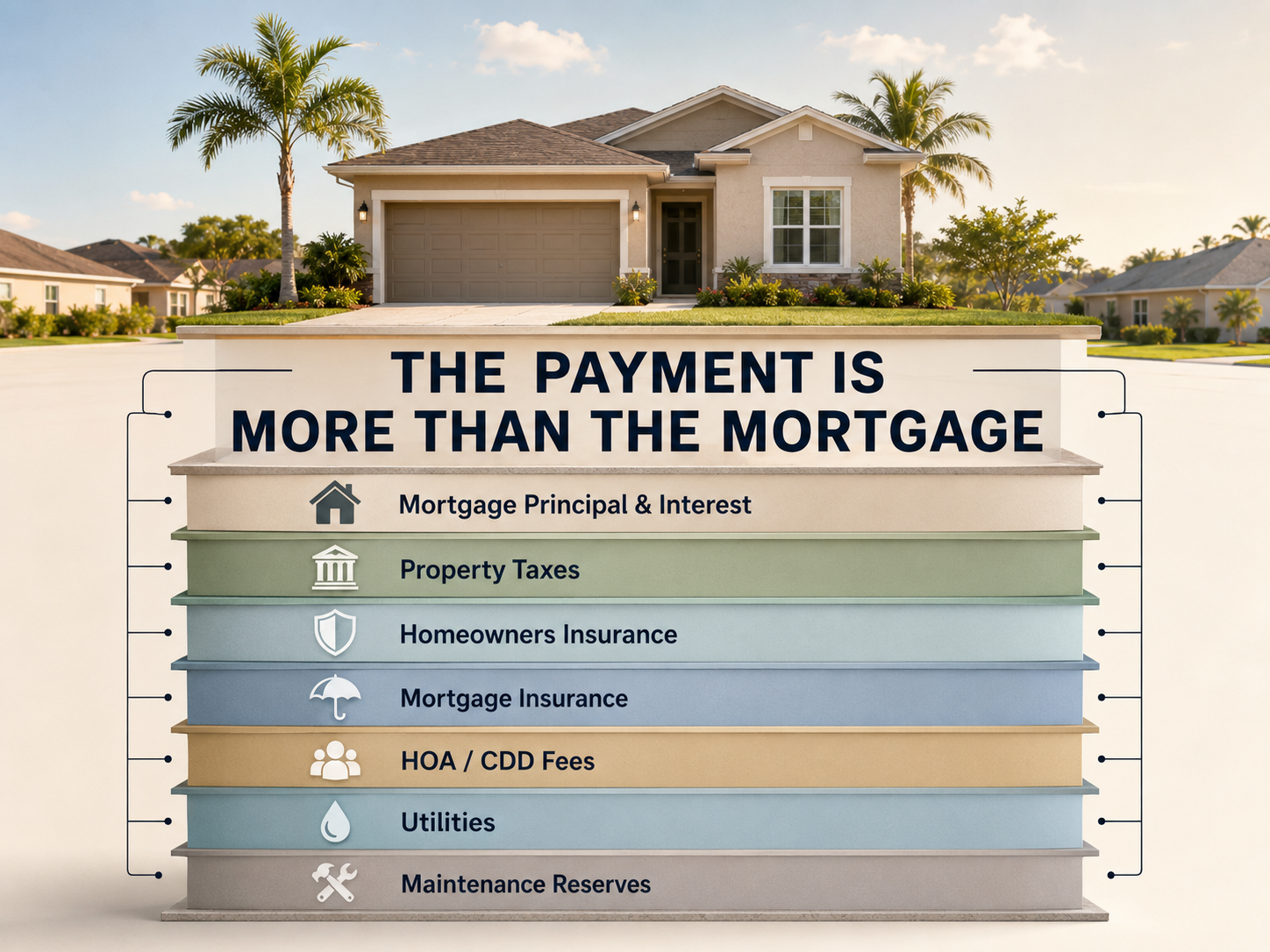
The complete housing cost may include:
- Mortgage principal and interest
- Property taxes
- Homeowners insurance
- Flood insurance when applicable
- Mortgage insurance when applicable
- HOA or condominium fees
- CDD assessments in some communities
- Utilities
- Routine maintenance
- Major repairs and replacements
- Additional commuting or transportation costs
The responsible target is not the payment you can survive during a perfect month. It is the payment you can manage while continuing to save and absorb the occasional financial ambush.
Seven Strategies That Can Improve the Equation
There is no clever financing trick that makes every Orlando home affordable. But several legitimate strategies can improve a buyer’s position.
1. Set the payment before selecting the price
Decide what total monthly housing cost is comfortable before browsing homes. Ask a lender to work backward from that payment using realistic estimates for taxes, insurance, mortgage insurance, and association fees.
This may produce a lower target price than the lender’s maximum approval. That is not bad news. It is useful information received before an expensive mistake.
2. Expand the property search—not merely the map
Buyers often say they have expanded their search because they added five miles to the radius. But the bigger savings may come from reconsidering the type, size, age, or amenity package of the property.
Options may include:
- A townhome instead of a detached house
- A smaller home in a preferred location
- An older home with sound major systems
- A home without resort-style community amenities
- A property needing cosmetic—but not structural—updates
- A community outside the most heavily marketed ZIP codes
- A multigenerational layout that allows costs to be shared appropriately
The lower-priced choice is not automatically the better one. Townhome and condominium fees, insurance requirements, reserves, assessments, and use restrictions must be reviewed carefully.
3. Negotiate for the right financial benefit
A price reduction is easy to understand, but it may not create the largest immediate benefit.
Depending on the loan and the buyer’s goals, a seller concession may be used toward eligible closing costs, prepaid expenses, or a mortgage-rate buydown. That can preserve the buyer’s cash or reduce the early monthly payment more than an equivalent reduction in purchase price.
| Strategy | Primary benefit | Important limitation |
|---|---|---|
| Price reduction | Permanently lowers the price and loan amount | A modest reduction may create only a small monthly saving |
| Closing-cost concession | Reduces cash needed at closing | Does not automatically reduce the long-term payment |
| Permanent rate buydown | May lower the payment for the life of the loan | Cost and break-even period must be calculated |
| Temporary rate buydown | Lowers payments during the first one to three years | Buyer must qualify for and afford the permanent payment |
| Repair credit | Preserves cash for known post-closing work | Loan and appraisal rules may limit the structure |
For a deeper comparison, read Seller Concessions vs. Price Reduction in Orlando .
4. Compare several loan structures and lenders
Rate is important, but it is not the only variable. Buyers should compare lender fees, mortgage-insurance costs, points, credits, loan types, prepayment rules, and the cash required to close.
The CFPB recommends obtaining and comparing official Loan Estimates before making a final lender decision. A slightly lower advertised rate can be a poor trade when it requires substantial upfront points or comes with higher fees elsewhere.
5. Investigate assistance programs without assuming eligibility
Florida Housing offers first-mortgage programs through participating lenders, and eligible borrowers may also qualify for second-mortgage assistance for down payment and closing costs. Florida’s Hometown Heroes program serves income-qualified, first-time buyers in eligible workforce occupations and provides assistance toward down payment and closing costs.
Orange County also maintains a first-time homebuyer down-payment-assistance program, subject to funding, income, property, lender, and education requirements. Program availability can change, and some funds are limited.
Assistance can address the cash-to-close barrier. It does not necessarily solve an unaffordable monthly payment, and some assistance takes the form of a deferred second mortgage rather than free money.
Buyers should verify current funding and repayment terms with an approved lender or program administrator before relying on assistance in a purchase plan.
Explore current information on Florida Hometown Heroes and other buyer-assistance options .
6. Examine builder incentives—but price the entire package
Orlando-area builders may advertise reduced interest rates, closing-cost assistance, design incentives, or quick-move-in discounts. Those incentives can be meaningful, particularly when the builder’s preferred lender is subsidizing the financing.
Buyers should still compare:
- The permanent interest rate after any temporary buydown
- The builder’s lender fees
- The base price and lot premium
- HOA and CDD costs
- Estimated property taxes after completion
- Insurance costs
- Included upgrades versus additional options
- Nearby resale competition
An incentive is valuable only when the complete deal is competitive. A “free” refrigerator is not a financial strategy, regardless of how aggressively the sales representative points at the stainless steel.
7. Improve the borrower before increasing the budget
Credit improvement, reduction of high-interest debt, increased savings, and a larger emergency reserve may have more value than forcing a purchase six months too early.
A better credit profile may improve the available interest rate or mortgage insurance. Paying off a monthly debt can improve cash flow and lending ratios. Additional savings can prevent the down payment from consuming every available dollar.
Delaying a purchase with a specific plan is different from waiting vaguely for the market to become perfect.
Strategies That Sound Good but Can Go Badly
“Buy now. You can always refinance later.”
Refinancing may become possible if rates decline, the property appraises, the borrower remains qualified, and the savings justify the closing costs. None of those conditions is guaranteed.
A future refinance is an opportunity, not a financial plan.
Using every available dollar for the purchase
A buyer who closes with no meaningful reserve is one repair, insurance deductible, medical bill, or employment disruption away from financial trouble.
Owning a home without reserves is not security. It is renting from the bank while volunteering as the unpaid maintenance department.
Stretching because income should rise later
Future raises, bonuses, overtime, refinancing, or a second income may improve the situation. The purchase should still work using dependable income and the permanent payment known today.
Buying a condominium because the price is lower
Condominiums can offer a lower entry price, but the monthly association fee, reserve funding, insurance structure, pending assessments, building condition, financing eligibility, and use restrictions must be examined.
A $275,000 condominium is not necessarily more affordable than a $325,000 townhome when the condominium carries a large monthly fee or a looming assessment.
Waiting for a dramatic crash without doing anything else
Prices can decline. Rates can fall. Inventory can rise. Economic conditions can deteriorate. Nobody can guarantee the timing or size of those changes.
Waiting may be the right decision, but the useful version of waiting includes improving credit, reducing debt, saving cash, monitoring target areas, and defining the conditions that would make buying worthwhile.
When Renting Is the Responsible Answer
Renting is not evidence that someone failed an adulthood examination. Homeownership is not automatically the superior decision in every season of life.
Continuing to rent may make sense when:
- You expect to relocate within a few years
- Your income is unstable or likely to change
- You have little emergency savings
- You would retain significant high-interest debt after closing
- The only available homes require unacceptable compromises
- The complete ownership payment exceeds your comfort level
- You need time to improve credit or reduce monthly obligations
- You value mobility and do not want maintenance responsibility
The comparison should be between the real rental situation and the real purchase—not between today’s mortgage payment and what someone’s parents paid for rent in 1996.
Rent is not “throwing money away.” It purchases shelter, flexibility, and freedom from many ownership expenses. Homeownership can build equity over time, but it also includes interest, taxes, insurance, maintenance, and transaction costs that do not become equity.
When Buying Is Worth Exploring
Buying may deserve serious analysis when the household has:
- Stable, documentable income
- A payment that fits without depending on refinancing
- Emergency reserves remaining after closing
- A multi-year ownership horizon
- Manageable consumer debt
- Flexibility around property type, condition, or location
- A clear lifestyle reason for owning
- Access to useful financing, concessions, benefits, or assistance
The purpose of an affordability review is not to find a way to say yes. It is to reach an informed answer.
Orlando-Specific Perspective
The Orlando market is not one market. Affordability can vary dramatically by county, neighborhood, property type, age, insurance profile, HOA structure, and commuting requirements.
A buyer concentrating only on Lake Nona, Winter Park, Baldwin Park, or newer master-planned communities will see a different affordability picture than a buyer considering portions of Seminole, Osceola, Lake, Volusia, or Polk counties. Expanding the search can help, but transportation costs and quality-of-life tradeoffs belong in the calculation.
A Practical Orlando Affordability Review
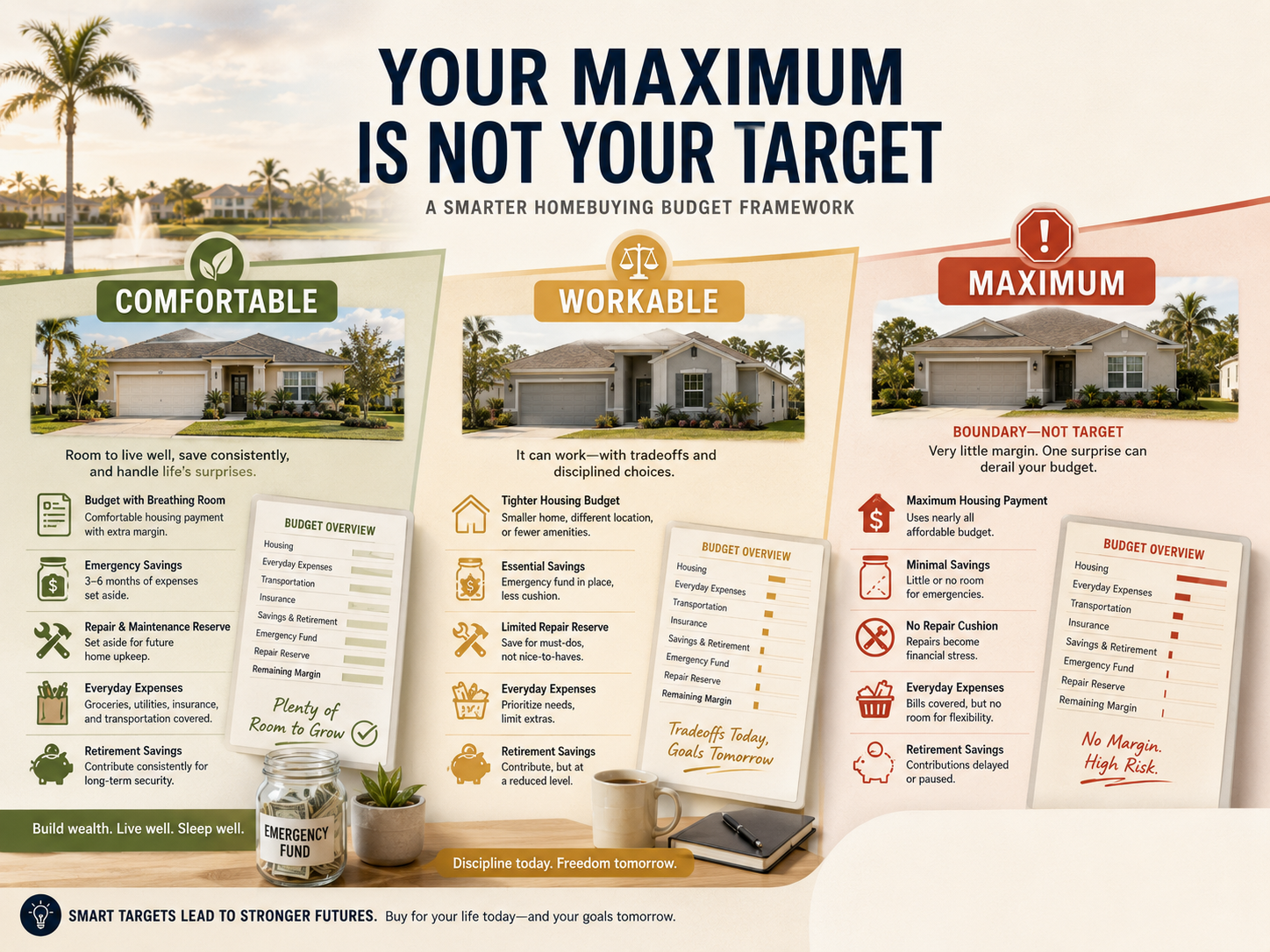
Before touring homes, build three scenarios with a qualified lender and a local real estate professional:

| Scenario | Purpose | Questions to answer |
|---|---|---|
| Comfortable | Protects savings and lifestyle | What payment feels sustainable even during a difficult month? |
| Workable | Allows measured compromises | What changes in location, size, or spending would be required? |
| Maximum | Defines the boundary—not the target | At what point does the purchase create unacceptable financial strain? |
| Scenario | Purpose | Questions to answer |
|---|---|---|
| Comfortable | Protects savings and lifestyle | What payment feels sustainable even during a difficult month? |
| Workable | Allows measured compromises | What changes in location, size, or spending would be required? |
| Maximum | Defines the boundary—not the target | At what point does the purchase create unacceptable financial strain? |
Then evaluate actual homes using the full estimated payment, cash-to-close, insurance quote, property condition, association documents, tax estimate, and likely maintenance.
Do not rely on a generic online calculator for the final decision. Florida insurance, taxes, HOA costs, CDD assessments, mortgage insurance, and loan pricing can materially change the result.
Frequently Asked Questions
Is homeownership still affordable in Orlando?
It is affordable for some households, but not for every household or every property. Orlando’s home prices, mortgage rates, insurance, taxes, and ownership costs have made buying significantly harder. The correct answer depends on the buyer’s income, debts, reserves, target payment, timeline, location, and available financing.
Should I keep renting instead of buying in Orlando?
Renting may be the better decision if you expect to move soon, have unstable income, lack emergency reserves, carry expensive debt, or cannot find an acceptable home within a comfortable payment. Buying should improve your long-term stability, not create immediate financial stress.
Will waiting for mortgage rates to fall make Orlando homes affordable?
Lower rates would improve borrowing power, but they could also attract more buyers and support higher prices. No one can guarantee when rates will fall or how the Orlando market will respond. A purchase should work at the permanent payment available today rather than depend on a future refinance.
Can seller concessions make an Orlando home more affordable?
They can help by reducing eligible closing costs, preserving cash, or funding an approved mortgage-rate buydown. Concessions cannot overcome a payment that is fundamentally too high, and their use is limited by the loan program, appraisal, contract, and lender rules.
Are down-payment-assistance programs free money?
Not always. Some programs provide grants, while others use deferred, forgivable, or repayable second mortgages. Eligibility, funding, occupancy requirements, income limits, and repayment terms vary. Buyers should confirm the current rules with an approved lender or program administrator.
How much should I spend if a lender approves me for more?
Base the decision on a complete household budget rather than the maximum approval. Include taxes, insurance, association fees, utilities, maintenance, savings goals, debt payments, and expected life changes. The maximum approval should be treated as a boundary, not a shopping target.
The Bottom Line
Orlando’s affordability crisis cannot be solved by pretending prices are reasonable, comparing current rates with 1981, or telling people to stop buying coffee.
Buyers also should not allow the daily flood of negative housing news to make the decision for them. National headlines cannot measure an individual household’s budget, timeline, benefits, target neighborhoods, or ability to negotiate a particular property.
You do not control the entire housing market. You do control how honestly you assess your finances, which compromises you will consider, what programs and financing strategies you investigate, and whether a specific purchase improves your life.
Start With the Numbers—not the Listings
Request an Orlando Homebuying Affordability Review
A homebuying affordability review is not a commitment to purchase and it is not a sales pitch disguised as a calculator. We will look at your target payment, likely ownership costs, realistic Orlando-area options, and the professionals who may need to be involved.
I can connect you with appropriate lending, insurance, credit, or assistance-program professionals so you can determine what would need to be true for buying to make sense.
And if the responsible answer is “not yet,” that is useful information too.
Request an Affordability Review
Call or text 321-321-2372 or email ted@orlandonest.com.
Sources and Further Reading
- Orlando Regional REALTOR® Association Housing Market Narrative
- Freddie Mac Primary Mortgage Market Survey
- Harvard Joint Center for Housing Studies: State of the Nation’s Housing 2026
- Consumer Financial Protection Bureau: Figuring Out What You Can Afford
- Florida Housing Homebuyer Programs
- Orange County Homebuyer Down Payment Assistance
Ted Moseley is a Central Florida REALTOR® with Orlando Nest and Real Broker, LLC, helping buyers make clear, locally informed real estate decisions throughout Orlando and the surrounding Central Florida communities.
Categories
Recent Posts








STAY UP TO DATE WITH THE MARKET