
What Does “Orlando” Actually Include? Cities, Counties, and Neighborhoods Explained
“We’re going on vacation to Orlando.”
“Great. Where are you staying?”
“Down by the parks—in Davenport.”
Welcome to Central Florida geography.
Calling Davenport “Orlando” works well enough when you are explaining your vacation to someone back home. It works considerably less well when you are choosing a house, calculating a commute, checking a school assignment, or figuring out which local government will collect your taxes.
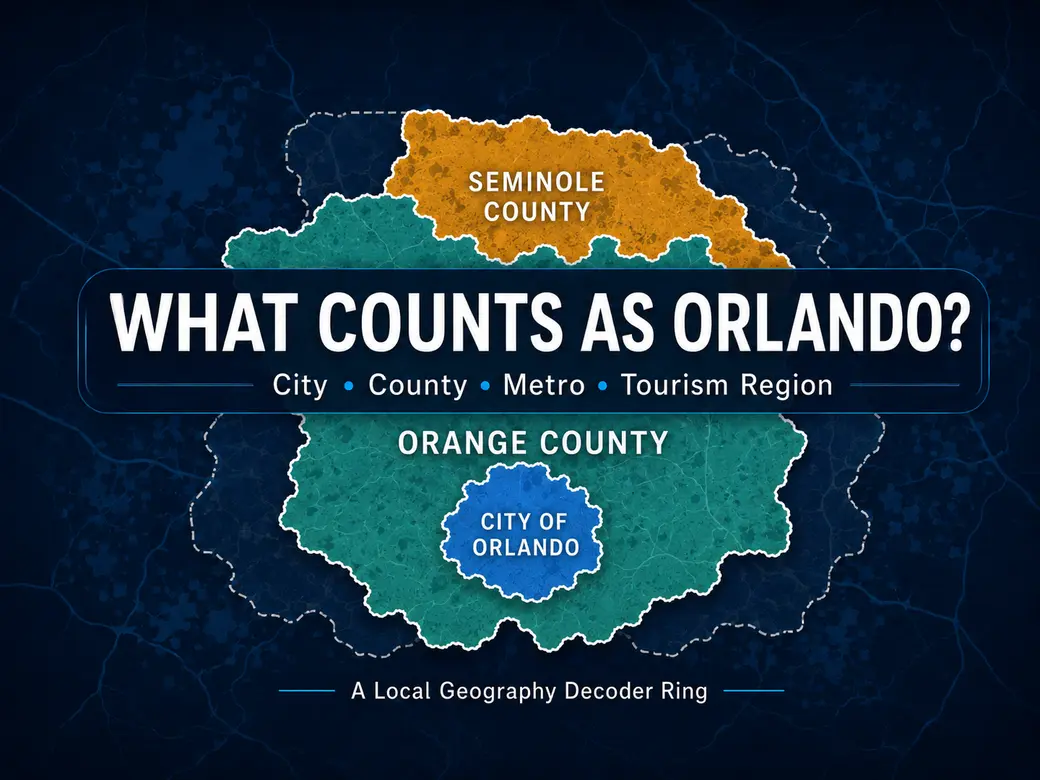
The confusion happens because Orlando can mean several different things at the same time. It may refer to the incorporated City of Orlando, an Orlando mailing address, the four-county metropolitan area, the tourism region surrounding the theme parks, or the broader housing market people casually call Greater Orlando.
None of those uses is necessarily wrong. They simply describe different maps.
For someone moving to Central Florida, the goal is not to memorize every boundary. It is to understand which version of “Orlando” applies to the decision you are making.
Quick Summary
The City of Orlando is only one part of the much larger Orlando region. A property described as being “in Orlando” could be inside Orlando city limits, in unincorporated Orange County with an Orlando mailing address, or in a separate city or county within Greater Orlando.
That distinction can affect local government, property taxes, utilities, school assignments, zoning, services, and—perhaps most importantly—your daily commute.
Orlando Is a City, but It Is Also a Regional Label
The City of Orlando is an incorporated municipality located in Orange County. It has defined boundaries, an elected mayor and city council, its own police department, municipal services, and city-specific land-use rules.
That is the legal version of Orlando.
The everyday version is much larger.
When employers discuss the Orlando labor market, visitors talk about an Orlando vacation, or housing reports describe Orlando real estate, they may be referring to communities spread across several counties.
That broader region can include places such as Winter Park, Maitland, Oviedo, Lake Mary, Winter Garden, Kissimmee, Celebration, Clermont, Davenport, Sanford, St. Cloud, and Altamonte Springs.
Those places may be part of the Orlando region, but they are not neighborhoods within the City of Orlando.
Some are independent municipalities. Some are unincorporated communities. Several are in counties other than Orange County.
“Orlando” is often being used as a regional shortcut rather than a precise location.
The Five Different Meanings of “Orlando”
The easiest way to decode the area is to recognize the five common ways the name is used.
1. The City of Orlando
This is the incorporated municipality with official city limits.
It includes Downtown Orlando and many recognizable neighborhoods and communities such as College Park, Delaney Park, Baldwin Park, and Lake Nona. A property inside the City of Orlando is governed locally by the City of Orlando.
2. An Orlando Mailing Address
A home can have “Orlando, Florida” in its mailing address without being located inside Orlando city limits.
Large portions of Orange County are unincorporated. Those areas are governed directly by Orange County, even though the postal address may say Orlando.
The Postal Service needs an address that gets the mail to the right place. It is not responsible for explaining municipal government—and, frankly, it already has enough going on.
3. Greater Orlando
Greater Orlando is the broader metropolitan region centered around Orlando.
The official Orlando–Kissimmee–Sanford Metropolitan Statistical Area includes four counties:
- Orange County
- Seminole County
- Osceola County
- Lake County
This regional definition is useful for employment data, population statistics, transportation planning, and economic reporting. It does not create one unified Greater Orlando government.
4. The Orlando Tourism Region
Tourism stretches the Orlando label even farther.
Visitors may describe hotels and vacation rentals in Kissimmee, Celebration, ChampionsGate, Davenport, or other communities near the attractions as being “in Orlando.” Tourism businesses also use Orlando because it is the destination name travelers recognize.
That shorthand makes sense when the question is, “Are we close enough to drive to Disney?”
It is not nearly specific enough when the question is, “Would I want to make this drive to work five days a week?”
5. The Orlando Real Estate Market
Real estate professionals, economists, news outlets, and homebuyers may use “the Orlando market” to describe housing activity throughout much of Central Florida.
That can be helpful when discussing broad regional trends. It becomes less useful when comparing two actual homes.
A market report covering Greater Orlando cannot tell you whether one property is served by Orange County Public Schools and another by Seminole County Public Schools. It cannot explain the difference between living near Downtown Orlando and commuting from western Osceola County.
Regional statistics provide context. Real estate decisions happen one address at a time.
The Orlando Geography Decoder Ring
Think of the area as a series of layers:
- Central Florida — the larger general region
- Greater Orlando — the metropolitan area
- County — such as Orange, Seminole, Osceola, or Lake
- Municipality or unincorporated area — the government serving the property
- Community or neighborhood — the place people identify with locally
- Subdivision — the specific development or recorded neighborhood
- Property address — the individual home and parcel
A single property might therefore be described as:
A Real Orlando-Area Example
A home in Waterford Lakes, within the Alafaya area of unincorporated Orange County, using an Orlando mailing address, in the Greater Orlando metropolitan area.
That sounds like someone spilled a box of geography terms on the kitchen table. But each layer answers a different question.
“Waterford Lakes” helps describe the community. “Unincorporated Orange County” identifies the local government. “Orange County” identifies the county and public school district. “Orlando” helps deliver the mail and tells someone roughly where the property is located. “Greater Orlando” connects it to the regional economy and housing market.
Orange County: Orlando and Much More
Orange County contains the City of Orlando, but most Orange County residents do not live inside Orlando city limits.
Orange County reports that approximately 62% of its residents live in unincorporated areas. In those locations, the Orange County Board of County Commissioners serves as the local government rather than a city council.
Orange County also contains separate incorporated municipalities, including:
- Orlando
- Winter Park
- Maitland
- Winter Garden
- Ocoee
- Apopka
- Windermere
- Belle Isle
- Edgewood
- Eatonville
- Oakland
- Bay Lake
- Lake Buena Vista
Winter Park, for example, is not an Orlando neighborhood. It is a separate city with its own municipal government, police department, fire services, and local identity. Its public schools, however, are part of Orange County Public Schools.
That distinction illustrates why city boundaries and school-district boundaries should not be treated as the same thing.
What “Unincorporated Orange County” Means
An unincorporated area is simply a portion of the county that is not located inside an incorporated city or town.
These areas do not have their own mayor or city council. Orange County provides the primary local government services and administers county zoning and land-use regulations.
Well-known unincorporated areas include:
- Dr. Phillips
- Horizon West
- Pine Hills
- Alafaya
- Waterford Lakes
- Hunters Creek
Some community names refer to census-designated areas. Others describe master-planned communities, developments, or locally recognized neighborhoods. The boundaries people use in conversation may not perfectly match legal, postal, census, or real estate boundaries.
That does not make the community name meaningless. It means you should confirm the jurisdiction of a specific property rather than relying entirely on the label attached to the listing.
Seminole County Is Part of the Orlando Story
Immediately north of Orange County is Seminole County, another major part of the Greater Orlando housing market.
Seminole County includes seven incorporated cities:
- Altamonte Springs
- Casselberry
- Lake Mary
- Longwood
- Oviedo
- Sanford
- Winter Springs
It also contains substantial unincorporated territory. A property may have a familiar community or postal name without being located within that city’s municipal boundaries.
Buyers often consider Seminole County because of its housing options, employment access, communities, parks, and school district. But Oviedo, Winter Springs, Lake Mary, and Sanford are not parts of the City of Orlando.
They are separate cities within the Greater Orlando region.
Osceola, Lake, and Polk Counties Complicate the Map Further
Osceola County forms the southern portion of the official four-county Orlando metropolitan area. It includes Kissimmee, St. Cloud, Celebration, and extensive development connected to the tourism and hospitality economy.
Lake County forms the northwestern portion of the metro. Communities such as Clermont are frequently included in relocation discussions, especially for buyers considering western Orlando employment centers or the Disney-area corridor.
Then there is Polk County.
Polk County is not part of the official four-county Orlando metropolitan statistical area, but its northeastern communities overlap with the Orlando housing and tourism region.
Davenport is the perfect example. It is a city in Polk County, yet nearby resorts, vacation communities, and residential developments are regularly marketed around their access to Orlando’s attractions.
So yes, someone can stay in Davenport and tell their friends they vacationed in Orlando.
Just do not assume that means Davenport and Downtown Orlando are neighbors. Central Florida has a mischievous sense of scale.
Why the Exact Location Matters When Buying a Home
The geography is more than trivia. It can affect practical and financial decisions.
Local government
The property may be governed by a city or directly by the county. That affects which government handles zoning, permitting, code enforcement, roads, and certain public services.
Property taxes and assessments
Taxing authorities and millage rates can differ by jurisdiction. Two nearby properties with similar mailing addresses may not have identical tax structures.
Past tax bills should also be reviewed carefully because an owner’s exemptions and assessed value may not transfer to the buyer.
School assignments
Public school districts generally follow county lines, but individual school assignments depend on the property address and current attendance boundaries.
A community name, ZIP code, or city name is not enough to verify the assigned schools.
Utilities and services
Water, sewer, trash collection, police, fire protection, and other services may be provided by a city, county, authority, utility company, or some combination of them.
Zoning and property use
Local rules can affect additions, accessory structures, rental use, home businesses, parking, and future development.
These questions become particularly important for buyers considering short-term rentals, larger lots, guest houses, multigenerational living, or unusual property uses.
Commutes
This may be the biggest issue of all.
A buyer moving for a job “in Orlando” could be commuting to Downtown Orlando, Lake Nona Medical City, the tourism corridor, UCF, Maitland, Lake Mary, or another employment center entirely.
Those destinations do not create the same home-search map.
A house may appear reasonably close on a regional map but require a very different daily drive once toll roads, congestion, limited routes, and cross-county travel are considered.
The Reality Check
Do not begin an Orlando home search by asking only, “How far is this from Orlando?” First decide which part of Orlando you actually need to reach—and how often.
How to Verify a Specific Orlando-Area Property
Before relying on a listing’s city name or community description, verify the individual address.
- Search the appropriate county property appraiser’s records.
- Confirm whether the property is inside a municipality or in an unincorporated area.
- Verify school assignments directly with the school district.
- Review the current tax record, while recognizing that the buyer’s future bill may differ.
- Confirm utility providers and any special districts or assessments.
- Test the commute during the time of day you would actually travel.
- Review association rules, zoning, and property-use restrictions that matter to your plans.
In Orange County, the county offers a wonderfully local clue: street signs displaying an orange generally indicate unincorporated Orange County. Orlando and Winter Park use their own identifying symbols.
That is useful when driving around, but the property appraiser’s records remain the better answer when accuracy matters.
From Understanding Orlando to Choosing a Community
This article answers, “What does Orlando include?”
The next question is more personal:
Which part of the Orlando area fits the way I want to live?
That depends on your budget, preferred housing style, commute, school needs, desired amenities, tolerance for association rules, and how much driving you consider reasonable.
The Orlando Neighborhood Guide can help you compare close-in neighborhoods, established suburbs, master-planned communities, and surrounding cities based on lifestyle and daily routine.
Understanding the map is step one. Choosing your place on it is step two.
Frequently Asked Questions
Is Orlando a city or a county?
Orlando is an incorporated city located in Orange County, Florida. Orange County is the county, while the City of Orlando is one municipality within it. The word Orlando is also commonly used for the broader metropolitan and tourism region.
Can I have an Orlando address without living in the City of Orlando?
Yes. Many properties in unincorporated Orange County use Orlando as their mailing address even though they are governed by Orange County rather than the City of Orlando. The mailing address alone does not confirm the municipality.
What counties are officially part of Greater Orlando?
The Orlando–Kissimmee–Sanford Metropolitan Statistical Area includes Orange, Seminole, Osceola, and Lake counties. Nearby portions of Polk and Volusia counties may still be associated with Orlando for commuting, tourism, or real estate purposes.
Is Winter Park part of Orlando?
Winter Park is part of the Greater Orlando region, but it is not part of the City of Orlando. It is a separate incorporated city in Orange County with its own municipal government.
Is Oviedo considered Orlando?
Oviedo is an independent city in Seminole County. It is part of the Greater Orlando metropolitan area but is not an Orlando neighborhood and is not located in Orange County.
Is Davenport part of Orlando?
Davenport is a city in Polk County and is not part of the City of Orlando or the official four-county Orlando metropolitan statistical area. It is often associated with the Orlando tourism and housing region because of its access to the attractions.
How do I know which city or county governs a property?
Search for the address through the county property appraiser and confirm the municipality or taxing district shown in the property record. Do not rely solely on the postal city, subdivision name, or wording used in a real estate advertisement.
Make the Map Work for You
Tell me where you need to be, what kind of home you want, and which compromises you would rather avoid. I’ll help you narrow Greater Orlando into a practical shortlist before you spend three weekends discovering that Central Florida is considerably wider than it looked on your phone.
Categories
Recent Posts






STAY UP TO DATE WITH THE MARKET