
Bank vs. Credit Union vs. Mortgage Broker: Which Is Best for an Orlando Home Loan?

A bank, credit union, or mortgage broker can each be the right choice for an Orlando homebuyer. The best option is the provider offering the strongest complete combination of interest rate, fees, loan-program fit, communication, and closing reliability for your specific situation.
Quick Summary
A bank may work well for a financially straightforward buyer who values convenience or relationship incentives. A credit union may offer competitive pricing and personalized service to eligible members. A mortgage broker can compare programs from multiple participating lenders and may be especially useful when income, credit, property type, or loan structure makes the file less conventional.
Do not choose by lender category alone. Compare at least two or three written offers using the same loan amount, loan type, down payment, lock period, points, and lender-credit assumptions.
Bank, Credit Union, or Mortgage Broker: What Is the Difference?
These terms describe how you gain access to mortgage financing, although the lines can become blurry.
A bank or direct mortgage lender generally offers loans through its own lending platform. Its loan officer represents that institution and can offer the programs available through that company.
A credit union is a member-owned financial institution. You normally must qualify for membership through location, employment, military service, an affiliated organization, or another eligibility route. Like a bank, a credit union generally lends through its own available programs.
A mortgage broker generally works with a group of wholesale lenders and helps match the borrower with one of those lenders. A broker may provide access to more options than one direct lender, but no broker represents every lender or every mortgage program in the market.
Bank vs. Credit Union vs. Mortgage Broker
| Factor | Bank or Direct Lender | Credit Union | Mortgage Broker |
|---|---|---|---|
| Loan access | Programs offered by that institution | Programs offered by that credit union | Programs from participating wholesale lenders |
| Membership required | Usually no | Usually yes | No |
| Potential strength | Convenience, established systems, relationship or specialty programs | Competitive pricing, member service, potentially lower fees | Broader comparison and options for unusual borrower profiles |
| Potential limitation | Only that institution's available products | Membership rules or a narrower program menu | Does not represent every lender; quality depends heavily on the individual broker |
| Possible best fit | Buyers whose needs align with the institution's programs | Eligible members receiving a competitive complete offer | Buyers who benefit from comparing multiple wholesale options |
These are tendencies, not guarantees. A large bank may have an excellent loan officer and an aggressively priced specialty program. A credit union may offer a strong rate but struggle with a tight closing schedule. A broker may find a creative solution for one borrower and still be more expensive than a direct lender for another.
The company category gets the provider into the conversation. The actual Loan Estimate tells you whether the offer deserves to stay there.
When a Bank May Be the Best Choice
Banks are sometimes dismissed as automatically expensive or inflexible. That is too simplistic.
A bank may be a strong choice when:
- You have substantial deposits, investments, or an established private-banking relationship.
- The bank offers a relationship discount or closing-cost incentive.
- You need a proprietary jumbo, physician, professional, or portfolio loan.
- Your income, credit, assets, and employment fit conventional underwriting cleanly.
- You value having banking, lending, and account management within one institution.
- The bank has a proven closing team that can meet your contract deadline.
Some banks retain certain mortgages in their own portfolios rather than selling them into the broader secondary market. A portfolio program may use different guidelines from a standard agency loan, but portfolio does not automatically mean easier, cheaper, or more flexible.
The Bank Limitation
A bank loan officer can generally offer only the products available through that institution. A helpful loan officer cannot produce a competing lender's program if the bank's own guidelines do not fit your situation.
When a Credit Union May Be the Best Choice
Credit unions deserve a serious look, particularly for borrowers who already qualify for membership.
The National Credit Union Administration's December 26, 2025 comparison reported an average 30-year fixed mortgage rate of 6.26% at credit unions and 6.50% at banks. It also reported lower credit-union averages for several other mortgage products.
Those national averages provide useful context, but they do not guarantee that a particular credit union will beat a bank, broker, or direct mortgage lender for your loan.
Your actual pricing can depend on:
- Credit profile
- Loan-to-value ratio
- Occupancy
- Property type
- Loan amount
- Discount points
- Rate-lock period
- Mortgage insurance
- Lender credits
- Program eligibility
A credit union may be worth prioritizing when:
- You qualify for membership without difficulty.
- The credit union has a competitive mortgage department, not merely competitive deposit products.
- Its lender-controlled fees compare favorably with other offers.
- You prefer a member-focused service model.
- The institution regularly handles your intended loan program and property type.
- Its underwriting process fits the deadlines in your purchase contract.
Credit Union Reality Check
Smaller does not automatically mean more personal, and member-owned does not automatically mean more flexible. Ask who processes and underwrites the mortgage, whether those functions are internal, and how quickly the institution has recently closed purchase loans similar to yours.
When a Mortgage Broker May Be the Best Choice
A mortgage broker can compare options from multiple participating wholesale lenders rather than offering only one institution's program menu.
That may be useful when:
- You are self-employed.
- Your income includes commissions, bonuses, overtime, contract work, or multiple sources.
- Your credit history requires a more careful lender match.
- You are purchasing a condominium with financing complications.
- You need an FHA, VA, jumbo, bank-statement, investor, or other specialized program.
- One lender has declined the file because of a guideline another lender may treat differently.
- You want someone to compare several wholesale channels on your behalf.
This does not mean brokers possess magical approval dust. Lenders must still document the borrower's ability to repay and follow applicable program requirements. The broker's practical value is often knowing where a particular borrower and property may fit—and where they probably will not.
How Mortgage Brokers Are Paid
The Consumer Financial Protection Bureau explains how mortgage loan officers and brokers are paid. Compensation is generally provided through a loan-specific fee or commission paid by the borrower or lender.
Federal loan-originator compensation rules restrict compensation based on certain loan terms and restrict some dual-compensation and steering practices. Buyers who want the underlying rule can review the CFPB's loan-originator compensation requirements under Regulation Z.
Buyers should still ask:
- Who is paying the broker?
- Where does the compensation appear?
- Does the quoted rate include points or lender credits?
- Which lenders were considered?
- Why is the recommended loan the best fit?
- Are lower-cost options available with different tradeoffs?
Transparency is not an insult to a good mortgage professional. A good professional should welcome an informed comparison.
Does a Mortgage Broker Always Get a Lower Wholesale Rate?
No. Wholesale describes the lending channel. It does not guarantee that the final borrower cost will be lower than a bank, credit union, or direct lender.
The final price may reflect:
- The wholesale lender's rate sheet
- Broker compensation
- Discount points
- Lender credits
- Loan-level pricing adjustments
- Rate-lock duration
- Property and borrower risk factors
- Third-party and lender-controlled fees
A broker may deliver the best offer. A bank or credit union may deliver the best offer. The reliable way to know is to compare equivalent written proposals.
Marketing labels are not math.
How Orlando Buyers Should Compare Mortgage Offers
The Consumer Financial Protection Bureau recommends comparing Loan Estimates for the same loan amount and type of loan.
Ask each provider to quote the same scenario:
- Same purchase price
- Same down payment
- Same loan type and term
- Same occupancy
- Same estimated credit profile
- Same rate-lock period
- Same number of discount points
- Same approach to lender credits
1. Interest Rate
The interest rate affects principal-and-interest payments, but it does not show the entire cost of the loan. Rates may also move during the day, so quotes issued at substantially different times may not be directly comparable.
2. Annual Percentage Rate
APR incorporates the interest rate and certain finance charges. It can help compare similarly structured loans but should not be used alone, particularly when comparing different loan types or expected ownership periods.
3. Discount Points
Discount points are upfront charges paid in exchange for a lower interest rate. Calculate how long the monthly savings will take to recover the upfront expense.
4. Origination Charges
Compare lender-controlled origination charges rather than allowing estimates for taxes, homeowners insurance, and prepaid items to distort the comparison.
5. Lender Credits
Lender credits reduce upfront closing expenses, usually in exchange for accepting a higher interest rate. This may be useful when preserving cash is more important than minimizing long-term interest, but the credit is part of the loan pricing.
6. Mortgage Insurance
For loans requiring mortgage insurance, compare both upfront and recurring costs. Two loans with the same interest rate may produce different total payments.
7. Cash to Close
Inspect why cash-to-close figures differ. One lender may estimate escrows, insurance, prepaid interest, or taxes differently. Focus first on costs and credits the lender controls.
For a deeper breakdown, read Orlando First-Time Buyer Closing Costs.
8. Five-Year Borrowing Cost
The Loan Estimate includes comparative figures showing interest, principal, loan costs, and other information over five years. This can be useful for buyers who may sell or refinance well before completing a 30-year loan term.
9. Closing Reliability
Price matters. So does performance. Missed financing, appraisal, and closing deadlines can create consequences beyond a slightly higher lender fee.
Ask each loan officer:
- How quickly can underwriting review the file?
- Is the approval fully underwritten or based on a preliminary review?
- How long are appraisals currently taking?
- Who handles processing?
- Who communicates when the loan officer is unavailable?
- Has the team recently closed loans similar to this one?
- Can the lender meet the closing date written into the contract?
The Rate Is Not the Entire Deal
A lender who is marginally cheaper but misses deadlines, communicates poorly, or discovers an underwriting problem two days before closing may become the most expensive option in the transaction.
See how long it takes to close on an Orlando home for the broader transaction timeline.
Orlando and Central Florida Factors That Can Change the Choice
Condominium Financing
Condominium loans may require review of the association's budget, insurance, reserves, litigation, owner-occupancy levels, milestone inspections, structural reports, and other project documentation.
A provider experienced with Florida condominium reviews may identify potential project-level problems earlier, reducing the chance of discovering a major financing issue after the buyer has paid for inspections and appraisal.
Homeowners Insurance
Florida homeowners insurance can materially affect a buyer's qualifying payment. Obtain realistic insurance quotes early, particularly for properties with older roofs, older electrical systems, prior claims, flood exposure, or other insurability concerns.
A lender may quote an attractive rate and still be unable to approve the loan if the actual insurance premium pushes the borrower's debt-to-income ratio beyond program limits.
New Construction
Builder-affiliated lenders may offer closing-cost incentives, rate buydowns, or design-center credits that outside lenders cannot match.
Compare the entire package:
- Purchase-price incentives
- Closing-cost credits
- Discount points
- Permanent or temporary rate buydowns
- Required affiliated services
- Loan fees
- Long-term payment
- Incentives lost by using an outside lender
An outside lender may quote a lower base rate and still lose the complete cost comparison. A builder lender may offer a large credit and recover part of it through loan pricing. Put both offers on paper.
Seller Concessions and Rate Buydowns
Different lenders may price permanent and temporary rate buydowns differently. Before negotiating a credit, determine what the lender will permit and how the proposed concession affects cash to close and monthly payment.
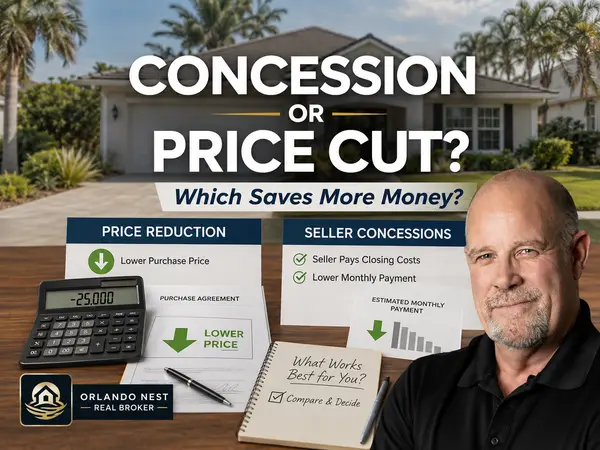
Our comparison of a seller concession versus a price reduction explains why the same negotiated amount can produce very different financial results.
Tight Contract Deadlines
An attractive quote has limited value if the provider cannot satisfy the financing and closing dates in the contract.
A well-organized national lender may outperform a local institution. A respected local lender may outperform a large call-center operation. Judge the actual operating team rather than the ZIP code printed beneath the logo.
Which Lender Type Is Best for a First-Time Orlando Buyer?
A first-time buyer should not choose a lender category first. The buyer should compare complete loan offers and service teams.
Credit unions may offer favorable fees or member programs. Banks may offer established first-time-buyer or relationship products. Brokers may help compare conventional, FHA, VA, down-payment-assistance, and other available options.
The strongest mortgage professional should also be able to explain:
- How much cash the buyer needs
- Whether adequate reserves will remain after closing
- How mortgage insurance affects the payment
- Whether assistance programs change the rate or fees
- How seller concessions may be used
- Whether paying points makes financial sense
- What happens if the appraisal is low
- Which costs may change before closing
Some assistance programs require participating lenders. Review current Orlando down-payment-assistance options before assuming that every provider can offer the same program.
A first-time buyer does not need the fastest salesperson. The buyer needs the clearest educator who can still execute.
Which Is Best for an Orlando VA Buyer?
VA buyers should focus less on the lender category and more on the provider's current experience with VA purchase loans.
VA-backed mortgages are obtained through private lenders, including banks, credit unions, and mortgage companies. The Department of Veterans Affairs guarantees part of the loan, but the borrower must still satisfy the applicable credit, income, occupancy, appraisal, and property requirements.
The Department of Veterans Affairs explains the available VA-backed loan types and reports that nearly 90% of VA-backed loans are made without a down payment.
Ask prospective VA lenders:
- How many VA purchase loans did your team close during the past year?
- Who orders and monitors the VA appraisal?
- Does the lender impose credit-score requirements above the underlying VA requirements?
- How does the underwriter calculate residual income?
- How is disability income documented?
- Does the team regularly handle partial entitlement?
- Can the loan officer explain the funding-fee exemption process?
- Has the team recently closed VA loans in Central Florida?
The best VA lender is the one that understands the program, communicates confidently with all parties, provides competitive terms, and can close—not necessarily the one with the loudest military-themed advertising.
Which Is Best for a Self-Employed Buyer?
A mortgage broker may be helpful because participating lenders can take different approaches to self-employment documentation and income calculations.
Banks and credit unions may also offer portfolio or professional programs that fit certain self-employed buyers. A broker cannot simply count income that the selected loan program does not permit.
Ask how the underwriter will treat:
- Business and personal tax returns
- K-1 income
- Depreciation
- Declining revenue
- Recent business formation
- Ownership percentage
- Cash retained in the business
- Large one-time deductions
- Commission or contract income
The right time to discover that a lender calculates your income differently is before you write an offer—not after the inspection.
Questions to Ask Every Mortgage Professional
- Which loan programs are you recommending, and why?
- Is this quote locked or floating?
- How many discount points are included?
- Are lender credits included?
- What are the total lender-controlled charges?
- What is the estimated five-year borrowing cost?
- How is the loan officer or broker compensated?
- Which expenses could still change?
- Has an underwriter reviewed my income and assets?
- Can your team meet the financing and closing deadlines?
- Who will communicate with me and my real-estate agent?
- What is the biggest potential underwriting issue in my file?
The final question is particularly revealing. A weak loan officer may say everything looks fantastic. A strong one will identify where the file could break and explain what needs to happen to prevent it.
Frequently Asked Questions
```Is a credit union always cheaper than a bank for a mortgage?
No. National-average data has sometimes shown lower mortgage rates at credit unions, but individual offers vary by borrower, property, program, points, credits, and fees. Compare written Loan Estimates issued for the same scenario.
Does a mortgage broker have access to every lender?
No. A mortgage broker generally works with multiple participating wholesale lenders, but not every lender in the market. A bank, credit union, or direct lender outside the broker's network may still offer a better program or price.
Who pays a mortgage broker?
Broker compensation may be paid by the borrower or lender, depending on the transaction structure. Federal rules restrict compensation based on certain loan terms, dual compensation, and steering. Compensation and loan costs should be disclosed in the mortgage paperwork.
Should I choose the lender with the lowest interest rate?
Not without comparing discount points, origination charges, lender credits, mortgage insurance, cash to close, and the five-year borrowing cost. Also confirm that the lender can meet the contract deadlines and manage foreseeable underwriting issues.
How many mortgage lenders should an Orlando buyer compare?
Comparing at least two or three providers normally gives the buyer enough information to identify meaningful differences in rates, fees, service, and loan structure. Request the quotes within a short period and use identical assumptions.
Can I change lenders after my offer is accepted?
Usually, but changing lenders can affect appraisal timing, financing deadlines, rate locks, and the closing date. Review the contract and coordinate with your real-estate agent before switching. Confirm in writing that the replacement lender can still close on time.
Choose the Loan Team That Fits the Transaction
The right financing partner is not determined by whether the sign outside says bank, credit union, or mortgage broker.
It is determined by whether the loan fits your finances, the property qualifies, the costs are competitive, the communication is clear, and the lender can fulfill the promises made before you signed the contract.
Planning an Orlando Home Purchase?
Before you write an offer, we can examine the property, financing structure, contract deadlines, and likely pressure points together so the mortgage and real-estate strategies are working from the same playbook.
Categories
Recent Posts







STAY UP TO DATE WITH THE MARKET