
What Are Closing Costs for Sellers in Florida?
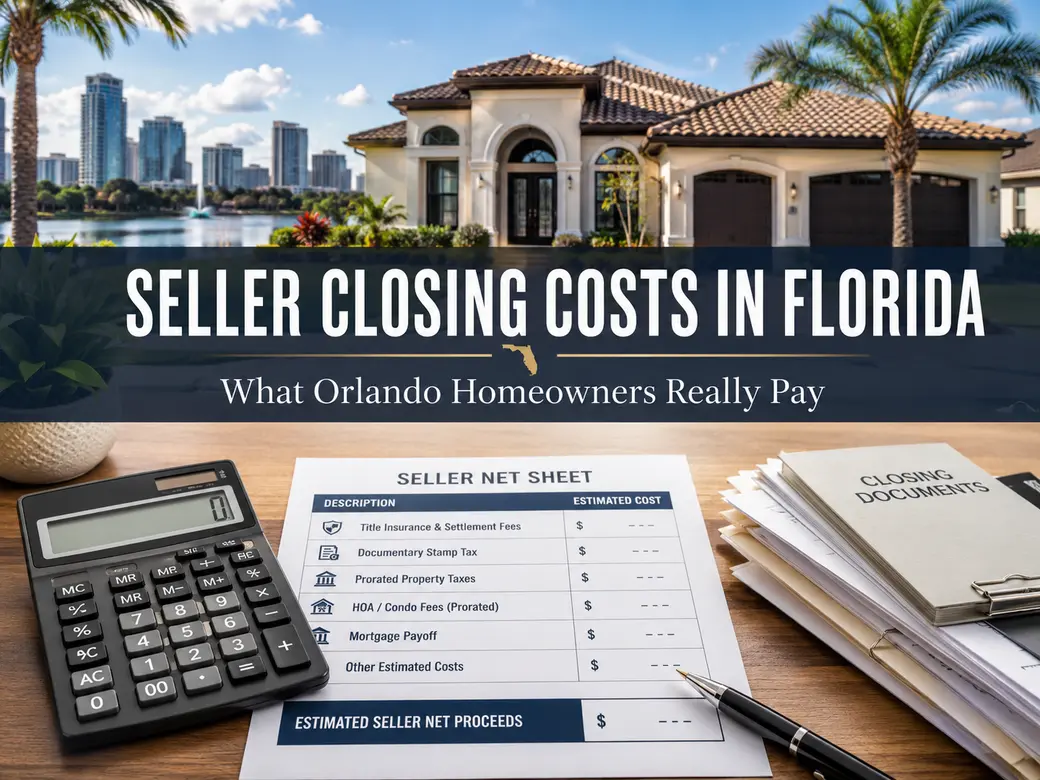
Florida home sellers commonly pay documentary stamp tax on the deed, prorated property taxes, title and settlement charges, mortgage payoff expenses, association-related fees, and any costs assigned to them in the purchase contract. Brokerage compensation, buyer concessions, repair credits, and mortgage balances can also reduce the seller’s proceeds, but those are best shown separately from the basic closing charges.
The number that matters is not a generic percentage. It is your estimated net proceeds after every expected deduction is listed individually.
That distinction matters because two Orlando homeowners selling for exactly the same price can walk away with very different amounts.
Quick Summary
A Florida seller’s expenses usually include documentary stamp tax, title and settlement charges, property-tax prorations, and any HOA or condominium costs. The seller may also have mortgage payoffs, brokerage compensation, buyer concessions, repairs, liens, or special assessments deducted from the sale proceeds.
The purchase contract determines who pays many of these expenses. Before listing your home, ask for a seller net sheet based on your property, likely sale price, mortgage balance, association, and anticipated contract terms.
What Counts as a Seller Closing Cost?
“Closing costs” is often used as a catch-all for anything deducted from a seller’s check. That is convenient, but it can also be misleading.
A useful seller net sheet separates the deductions into four categories:
- Transaction and government charges, such as documentary stamp tax and settlement fees.
- Property-related adjustments, such as prorated property taxes, HOA dues, special assessments, or unpaid utility obligations.
- Contractual expenses, including brokerage compensation, buyer closing-cost concessions, repair credits, and home-warranty costs.
- Debt and title obligations, including mortgage payoffs, home-equity lines, judgments, liens, and other amounts that must be cleared before the buyer receives title.
Your mortgage payoff may be the largest deduction on the settlement statement, but it is not really a cost of selling. It is repayment of money you previously borrowed.
Likewise, brokerage compensation and buyer concessions affect your bottom line, but they are negotiable contractual terms—not government-mandated closing fees.
Separating those categories gives you a much clearer answer to the question every seller is really asking:
How much money will I receive after the sale closes?
Common Florida Seller Expenses
| Potential deduction | How it is determined | Is it always seller-paid? |
|---|---|---|
| Documentary stamp tax | Based on the consideration shown on the deed | Customarily assigned to the seller in many transactions |
| Owner’s title insurance | Florida-regulated premium based primarily on coverage amount | No; responsibility depends on the contract |
| Title and settlement services | Title-company or closing-agent charges | Depends on the contract and services provided |
| Property-tax proration | Seller’s share through the agreed closing date | Usually shown as a seller debit or buyer credit |
| HOA or condominium charges | Estoppel, dues, assessments, transfer requirements, and account status | Depends on the charge and contract |
| Mortgage and lien payoffs | Amounts required to release claims against the property | Yes, when those obligations belong to the seller |
| Brokerage compensation | Negotiated in written brokerage agreements | Depends on the seller’s agreements |
| Buyer concessions | Negotiated in the purchase contract | No |
| Repair or inspection credits | Negotiated during the transaction | No |
Florida Documentary Stamp Tax on the Deed
Florida imposes documentary stamp tax when an interest in real property is transferred.
In every Florida county except Miami-Dade, the rate is generally $0.70 for each $100, or portion of $100, of consideration. That includes Orange, Seminole, Osceola, Polk, Lake, and Volusia counties. The tax is due when the deed is recorded.
Here are a few examples:
| Sale price | Documentary stamp tax |
|---|---|
| $350,000 | $2,450 |
| $400,000 | $2,800 |
| $500,000 | $3,500 |
| $750,000 | $5,250 |
| $1,000,000 | $7,000 |
This is one of the most predictable expenses in a Florida sale. Unlike a service fee or brokerage charge, the rate itself is set by law.
The purchase contract determines which party is responsible for paying it, although it is commonly assigned to the seller in standard resale transactions.
Who Pays for Title Insurance in Florida?
There is no statewide rule requiring every Florida seller to pay for the buyer’s owner’s title-insurance policy. Who pays depends on the purchase contract.
In many Central Florida transactions, the seller pays for the owner’s policy and selects the title or closing agent. However, buyers and sellers can negotiate a different arrangement.
That distinction becomes important when comparing offers.
A buyer who offers slightly more but asks the seller to pay for the owner’s title policy, substantial closing costs, and other credits may produce a lower net than a cleaner offer with a slightly lower price.
Florida regulates the premium rates for title insurance. For original owner coverage, the published rate is generally:
- $5.75 per $1,000 for the first $100,000 of coverage
- $5.00 per $1,000 from $100,000 through $1 million
- Lower incremental rates above $1 million
Discounts may apply in certain situations, including qualifying reissue transactions. Separate title-search, examination, settlement, municipal-lien-search, wire, courier, or other service charges may also appear.
For a deeper explanation, read the Orlando Nest guide to title insurance for Florida home sellers.
Contract Reality
“The seller pays title” is a local custom, not an unbreakable law of nature. The contract controls. That is why title responsibility needs to be considered when comparing the net value of competing offers.
Title and Settlement Charges
The title-insurance premium is not necessarily the only title-related charge.
Depending on the transaction and closing provider, the settlement statement may include charges for:
- Title search and examination
- Closing or settlement services
- Municipal lien searches
- Document preparation
- Payoff processing
- Courier or overnight delivery
- Wire transfers
- Recording and release services
- Additional work required to clear title defects
These fees are not all standardized, and they should not be estimated using one supposedly universal Orlando number.
A simple cash sale with clean title and no association may be relatively straightforward. A sale involving multiple mortgages, probate, divorce, an unreleased lien, an open permit, a trust, or a foreign seller can require substantially more work.
The closing agent should provide the actual estimated charges for the specific transaction.
Prorated Florida Property Taxes
Florida property taxes are generally paid in arrears. A tax bill issued near the end of the year covers that calendar year, while unpaid taxes become delinquent after March 31 of the following year.
Because the seller owned the property for part of the current year, the closing statement normally allocates the seller’s share through the date established by the contract.
The title company typically estimates the proration using the most recent available tax information. The seller’s portion may appear as a charge to the seller and a credit to the buyer, who later receives and pays the tax bill.
That proration is not an extra tax created by the sale. It is an allocation between the seller and buyer based on the period each owned the property.
The number can vary because of:
- Closing date
- Current assessed value
- Homestead and other exemptions
- Non-ad valorem assessments
- CDD assessments included on the tax bill
- Whether the latest tax bill has already been paid
- Contract language governing the proration
A seller’s existing homestead exemption and Save Our Homes benefit do not automatically transfer to the buyer’s future assessment. That is an important issue for buyers, but it does not change how the seller’s current-year tax proration is calculated at closing.
HOA and Condominium Costs
Association-governed properties can introduce several additional deductions.
The closing agent may need an estoppel certificate showing:
- Whether assessments are current
- Amounts presently owed
- Upcoming regular or special assessments
- Open violations
- Transfer or approval requirements
- Capital-contribution or resale fees
- Other associations connected to the property
Florida law limits the base amount an HOA or condominium association may charge for an estoppel certificate when the account is current. Additional charges may be allowed for expedited delivery or a delinquent account, and the statutory amounts can be periodically adjusted.
The estoppel charge itself is only one possible association expense. A seller may also encounter:
- Unpaid regular assessments
- Prorated dues
- Special assessments
- Transfer or resale-processing fees
- Required buyer-application charges
- Capital-contribution requirements
- Violation-related expenses
- Charges involving both a master association and a sub-association
Central Florida Detail
Many Orlando-area communities have more than one governing entity. A property may belong to a neighborhood association, a master association, and a separate condominium association. Each one can create its own documents, balances, approval requirements, or fees.
Before listing an association property, it is worth identifying every applicable association and asking whether there are pending assessments, transfer requirements, or unresolved violations.
Mortgage Payoff and Other Liens
If the seller has a mortgage, home-equity loan, home-equity line of credit, or other lien secured by the property, the closing agent must obtain payoff information and arrange for the obligation to be satisfied.
The payoff will often be slightly higher than the principal balance shown on a recent mortgage statement because it may include:
- Interest through the expected payoff date
- Recording or release charges
- Payoff-statement fees
- Late charges or other outstanding amounts
- A per-diem amount if closing is delayed
A home-equity line may also need to be formally closed, even when its balance is zero.
Other title obligations can include:
- Judgment liens
- Federal or state tax liens
- Code-enforcement liens
- Municipal utility balances
- Contractor or construction liens
- Child-support liens
- Probate or estate claims
- Unreleased prior mortgages
- Solar-financing obligations
These issues do not always prevent a sale, but they can delay closing or reduce proceeds if discovered late.
Brokerage Compensation
Real estate brokerage compensation is negotiable. It may be structured as a percentage, flat fee, or another arrangement agreed to in writing.
The compensation owed to the listing brokerage is governed by the listing agreement. Any amount the seller agrees to contribute toward a buyer’s brokerage costs or other buyer expenses should be separately stated in the applicable agreement or purchase contract.
This is another reason not to advertise one “standard commission” as though it applies to every Florida sale. It does not.
The useful question is not merely, “What is the rate?”
It is:
What services, strategy, representation, marketing, risk management, and expected net result am I receiving for the compensation?
A lower fee does not automatically create a higher net if the property sells for less, takes longer to sell, receives weaker offer management, or runs into preventable transaction problems.
Conversely, sellers should understand every charge and make informed comparisons. “That is what everyone pays” is not a substitute for a clear explanation.
Seller Concessions and Repair Credits
A seller may agree to pay some of the buyer’s closing costs, prepaid expenses, interest-rate costs, or other permitted expenses.
These concessions can make financial sense when they:
- Help a qualified buyer complete the purchase
- Produce a stronger overall price
- Solve an appraisal or inspection issue
- Improve the buyer’s payment without requiring a large price reduction
- Help the property compete against nearby listings or builder incentives
But a concession is still money deducted from the seller’s proceeds.
For example, these two offers are not financially equivalent:
- $500,000 with no seller concession
- $510,000 with a $15,000 seller concession
Before considering other differences, the second offer produces $5,000 less gross value to the seller.
Financing, appraisal risk, contingencies, closing timeline, repair requests, and likelihood of completion can change the decision further.
The headline price gets the attention. The net and the risk determine which offer is actually better.
For a deeper comparison, read seller concessions versus a price reduction in Orlando.
A Simplified $500,000 Seller Example
Consider a hypothetical Orlando-area home selling for $500,000.
Assume:
- The seller pays documentary stamp tax
- The seller pays an original owner’s title-insurance premium
- Estimated title coverage is $500,000
- The property has an HOA but no delinquency
- The seller provides no buyer concession
- Property-tax proration, settlement charges, mortgage payoff, and brokerage compensation are shown separately because they depend on the property and agreements
| Item | Illustrative amount |
|---|---|
| Sale price | $500,000 |
| Documentary stamp tax | $3,500 |
| Base original owner’s title premium | Approximately $2,575 before applicable discounts and other charges |
| HOA estoppel | Property- and association-specific |
| Property-tax proration | Depends on tax bill and closing date |
| Title and settlement services | Provider- and transaction-specific |
| Mortgage or lien payoff | Seller-specific |
| Brokerage compensation | Negotiated |
| Buyer concessions or repair credits | None in this example |
The point of the example is not to manufacture one deceptively precise total. It is to show which amounts can be calculated in advance and which require property-specific information.
Someone promising to calculate your exact seller proceeds from the sale price alone is missing half the worksheet.
Costs Sellers Often Forget
The settlement statement is not the only place where selling expenses occur.
Depending on the property and strategy, a seller may also spend money on:
- Repairs before listing
- Cleaning and landscaping
- Moving and storage
- Staging
- Photography or specialty marketing not included by the brokerage
- Inspections or engineering reports
- Survey work
- Permit resolution
- Termite or wood-destroying-organism treatment
- Temporary housing
- Insurance and utilities while the property remains on the market
- Interest, taxes, HOA dues, and maintenance during the listing period
These are not necessarily closing costs, but they affect the seller’s final financial result.
A good sale strategy evaluates both the expected proceeds and the money required to reach closing.
Can Florida Sellers Avoid Closing Costs?
Not entirely.
Some expenses are created by law or by obligations already attached to the property. Documentary stamp tax must be paid when required. Mortgages and valid liens must be resolved. Property taxes and association balances must be accounted for.
Other costs are negotiable:
- Who pays for the owner’s title policy
- Whether the seller gives a buyer concession
- How repairs are handled
- Brokerage compensation
- Home-warranty costs
- Certain settlement expenses
- Closing date and related prorations
The goal should not be to avoid every expense at any cost.
The better objective is to choose the contract and selling strategy that produces the strongest combination of:
- Net proceeds
- Closing certainty
- Reasonable timeline
- Manageable risk
- Terms that fit the seller’s next move
How to Estimate Your Net Before Listing
Start with a realistic expected sale-price range—not merely the highest automated valuation found online.
Then gather:
- Current mortgage statement
- Information for every home-equity loan or line
- Latest property-tax bill
- HOA and condominium contact information
- Notices of special assessments
- Solar agreements
- Information about liens, judgments, probate, divorce, trusts, or ownership changes
- Expected repair or preparation expenses
- Proposed brokerage terms
From there, create more than one scenario.
A useful seller net analysis may include:
- Conservative sale price
- Expected sale price
- Strong-outcome sale price
- A version with a buyer concession
- A version with likely repair or inspection credits
- Different closing dates when tax or carrying-cost differences matter
This is far more useful than subtracting an arbitrary percentage from an optimistic home value.
Ted’s Take
The sellers most likely to be surprised at closing are the ones who focus on the sale price and stop there. A $10,000-higher offer is not automatically better if it carries $15,000 in concessions, weaker financing, more inspection exposure, or a shaky appraisal.
I would rather give a homeowner an honest range before listing than celebrate a fantasy number and explain the deductions later. Build the net sheet early, update it when offers arrive, and make the decision using the whole contract.
Related Reading
Frequently Asked Questions About Florida Seller Closing Costs
```How much are seller closing costs in Florida?
There is no reliable percentage that applies to every Florida seller. Documentary stamp tax and certain title charges can be estimated from the sale price, but taxes, settlement fees, association charges, mortgage payoffs, brokerage compensation, concessions, repairs, and liens vary. A property-specific seller net sheet provides a much more useful estimate.
How is Florida documentary stamp tax calculated?
In Florida counties other than Miami-Dade, documentary stamp tax on a deed is generally calculated at $0.70 per $100, or portion of $100, of consideration. On a $500,000 transfer, that equals $3,500. The tax is due when the deed is recorded.
Does the seller have to pay for title insurance in Florida?
No statewide rule makes the seller pay in every transaction. In many Central Florida resale contracts, the seller agrees to pay for the buyer’s owner’s policy and selects the closing agent, but the parties can negotiate a different arrangement. The signed purchase contract controls.
Are real estate commissions included in seller closing costs?
Brokerage compensation is commonly deducted from the seller’s proceeds at closing, but it is better shown separately from government taxes, title charges, and settlement expenses. Compensation is negotiable and is established through written brokerage agreements.
What is the difference between closing costs and a mortgage payoff?
Closing costs are expenses associated with completing the transaction. A mortgage payoff is repayment of the seller’s existing debt secured by the property. Both reduce the amount delivered to the seller, but they represent very different things.
Can a seller pay a buyer’s closing costs in Florida?
Yes. A seller can agree to contribute toward permitted buyer expenses, subject to the purchase contract and any limits imposed by the buyer’s loan program. The concession should be evaluated together with the price, financing, appraisal risk, contingencies, and expected seller net.
How can I estimate what I will receive from selling my Orlando home?
Ask for a seller net sheet based on a realistic price range, mortgage payoff, tax bill, association information, expected title arrangement, brokerage agreement, and likely concessions or repairs. Update the net sheet when an offer arrives so the decision reflects the actual contract rather than only the headline price.
Ted Moseley is an Orlando REALTOR® with Real Broker, LLC, helping Central Florida homeowners evaluate pricing, contract terms, transaction risk, and expected net proceeds with clear-eyed advice.
Know Your Number Before You List
A home-value estimate tells you what your property might sell for. A seller net sheet estimates what you may actually keep.
Categories
Recent Posts









STAY UP TO DATE WITH THE MARKET