
The Black Hammock and Seminole County's Rural Boundary: What's at Stake as Oviedo Grows?
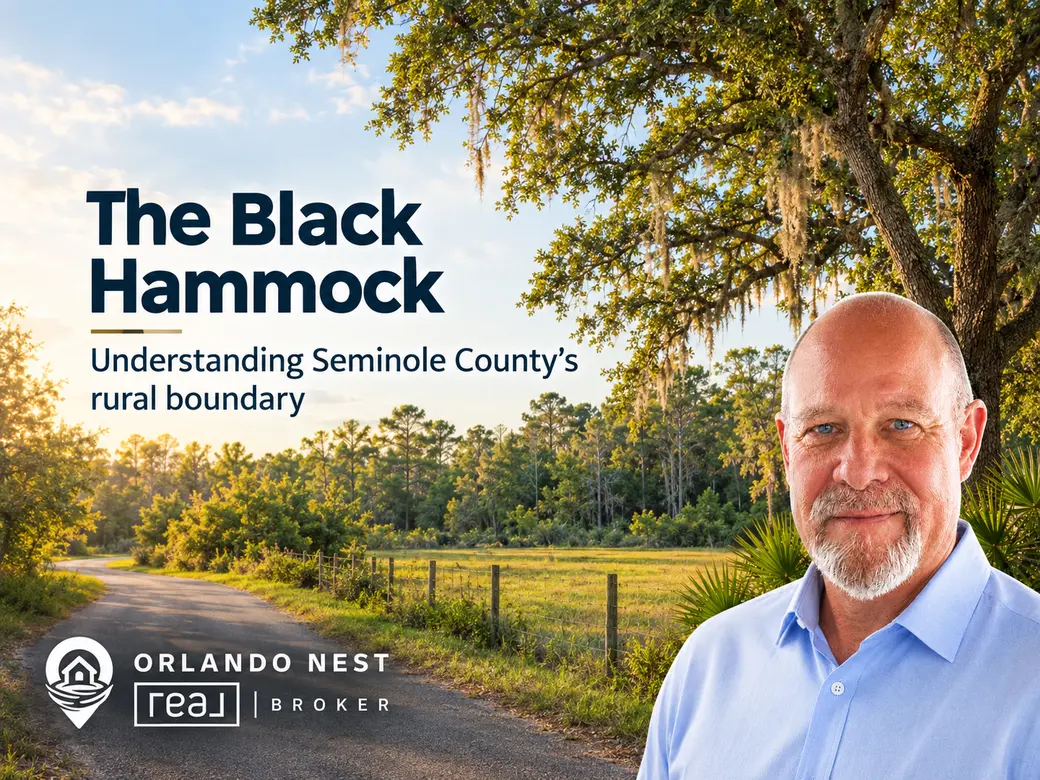
Seminole County's rural boundary helps preserve lower-density development, agriculture, and natural resources around communities such as the Black Hammock; it does not prohibit all new homes. The Strawberry Lane request concerns removing about 67 acres from the Rural Area, rather than granting final approval for its conceptual 136-home subdivision. For homeowners and buyers, the practical issue is understanding both the community's character and what surrounding land may legally become.
There aren't many places left around Orlando where you can turn off a busy road and, within a few minutes, feel like you've stepped back into Old Florida. The Black Hammock, tucked along the southern shores of Lake Jesup near Oviedo, is one of those places.
It's an area of winding roads, sprawling oak trees, open fields, and a way of life that feels increasingly rare in a region that has experienced so much growth.
For me, the Black Hammock is personal.
I played in bands at the original Lazy Gator at Black Hammock Adventures from the early 2000s until the pandemic in 2020. That old waterfront gathering place has its share of stories, and I was fortunate enough to be part of a few of them. In fact, one of those gigs is where I met the woman who would become my wife.
Over the years, my kids and I picked strawberries at Pappy's Patch. My wife and I even looked at property within the rural boundary, seriously considering making that little piece of Old Florida our home.
Those aren't just places on a map to me. They're part of my family's story.
And I know we're not alone. For generations of local families, places like Black Hammock Adventures and Pappy's Patch have been where memories were made. They're part of what gives this corner of Seminole County its identity.
That's why the current debate over development within Seminole County's rural boundary is about more than the number of homes that might be built.
The rural boundary helps protect the agricultural landscape, natural resources, and lower-density character that make eastern Seminole County distinctive. It doesn't prohibit all development, but it does establish important limits. Now, a proposal to remove approximately 67 acres near Oviedo from that boundary has brought a familiar question back to the forefront: How do we make room for growth without losing the very things that make a community special?
And while the latest discussion centers on the former Pappy's Patch property, the implications extend well beyond one piece of land.
What Makes the Black Hammock Different?
If you've driven through Oviedo in recent years, you've seen how much the area has changed.
New neighborhoods, commercial developments, and road improvements have reshaped portions of eastern Seminole County. Much of that growth has brought housing, services, and conveniences that residents use every day.
But the Black Hammock offers a striking contrast.
Here, you can still find agricultural properties, wooded roads, wetlands, and homes on larger parcels of land. The landscape feels less like the suburban communities surrounding Orlando and more like the Florida that existed before rapid metropolitan growth.
Lake Jesup is central to that setting.
The lake and its surrounding wetlands support an interconnected landscape of natural habitats, waterways, and conservation lands.
Among those protected places is the Black Hammock Wilderness Area, a roughly 700-acre conservation property managed by Seminole County. County park information.
Its approximately 4.5-mile trail system winds through hardwood swamps, pine flatwoods, and sand pine scrub. The county identifies wildlife including barred owls, white-tailed deer, bobcats, and eastern hognose snakes.
It's an area appreciated by hikers, photographers, wildlife enthusiasts, and residents who value the opportunity to experience Florida's natural environment.
Of course, the Black Hammock isn't one continuous nature preserve. It includes private properties, agricultural land, homes, and businesses alongside protected natural areas.
That mixture is part of what makes it distinctive.
The character of the Black Hammock comes from the relationship between the people who live there and the landscape around them.
Understanding that relationship helps explain why proposals for more intensive development can generate such strong reactions.
What Is Seminole County's Rural Boundary?
To understand the controversy, we need to understand what the rural boundary actually does.
In 1991, Seminole County established a Rural Area and Rural Boundary through its Comprehensive Plan. County background and current process.
The objective was to manage growth while protecting agricultural activities, natural resources, and the rural character of eastern Seminole County.
Think of a county's Comprehensive Plan as a long-term blueprint for how land is expected to be used.
Some areas are planned for higher-density residential communities, commercial development, and the infrastructure necessary to support them.
Other areas are intended for agriculture, lower-density residential uses, and the preservation of natural resources.
The rural boundary helps distinguish those areas and provides an additional layer of protection against the expansion of more intensive development into the county's designated Rural Area.
Does That Mean Development Is Prohibited?
No.
This is one of the most important distinctions in the discussion.
The rural boundary doesn't turn every property within it into permanently preserved conservation land.
Private property owners retain development rights consistent with applicable laws, zoning classifications, and land-use designations.
Homes can be built where existing regulations allow them.
What the rural boundary does is make it more difficult to change the established development pattern by removing land from the designated Rural Area.
That matters because a proposal to construct a limited number of homes under existing agricultural zoning is very different from a proposal requiring a boundary change to accommodate substantially greater density.
Seminole County Voters Have Reinforced These Protections
The rural boundary has been part of Seminole County's planning framework for decades.
In 2004, voters approved incorporating the rural boundary and related protections into the county's Home Rule Charter.
Then, in November 2024, voters strengthened those protections again.
More than 82% of participating voters supported a charter amendment requiring at least four of the five county commissioners to approve removing property from the designated Rural Area. County Manager's 2024 report.
Previously, a simple majority could approve certain changes.
That higher voting threshold is important because it requires broader agreement among elected commissioners before a boundary removal can proceed.
The referendum did not prohibit future changes. Nor was it a vote on the development proposal currently being considered.
It did, however, establish a higher standard of approval for changing a longstanding county planning boundary.
Why Is Pappy's Patch at the Center of the Discussion?
For many Oviedo families, Pappy's Patch was a familiar part of growing up in the area.
The former strawberry farm offered families an opportunity to pick their own berries and experience a small piece of Central Florida's agricultural heritage.
Today, that property is the subject of a proposed residential development known as Strawberry Lane.
Developer Chris Dorworth, a former Florida state representative, is seeking to remove approximately 67 acres near Florida Avenue and Deleon Street from Seminole County's rural boundary.
The development concept calls for as many as 136 single-family homes. Local reporting on the proposal and October meeting.
That number has become central to the public discussion.
Why Does the Rural Boundary Matter to This Proposal?
Under the property's existing agricultural designation, local reporting indicates that approximately 17 homes could potentially be developed, subject to applicable technical approvals.
The proposed Strawberry Lane development would involve considerably more homes.
To pursue that higher-density concept, the applicant is seeking a change to the property's rural-boundary status.
Here's the distinction worth remembering:
Approval to remove the land from the rural boundary would not, by itself, authorize construction of 136 homes.
It would represent a significant step toward the proposed development, but additional land-use, zoning, and development approvals would still need to be addressed. The county's staff report describes the current request as rural-area removal, without an associated rezoning or future land-use map amendment; it recommends denying transmittal of the related Comprehensive Plan text amendments to state reviewing agencies.
That separation is important because public discussions sometimes treat the boundary-removal request and final subdivision approval as though they are the same decision.
They aren't.
What Has Happened So Far?
On October 7, 2026, the Seminole County Planning and Zoning Commission considered the Strawberry Lane request.
After a meeting lasting nearly four hours, the commission recommended denying the proposed rural-boundary change.
That recommendation aligned with county planning staff's position.
Staff questioned whether the application provided sufficient justification for removing the property from the designated Rural Area. County case 2026-0772 and staff analysis.
The applicant, however, presented a different perspective.
Dorworth argued that the property is close to existing residential subdivisions and that the proposal represents a logical extension of nearby development.
He also emphasized the rights of property owners and the need for additional housing in a growing region.
County planners challenged the argument that the property was substantially surrounded by suburban development, pointing to the extent of adjoining land with rural designations.
These competing interpretations are important because land-use decisions frequently depend on more than simply counting proposed homes.
They involve compatibility with surrounding properties, existing planning policies, infrastructure, and the standards established for changing development designations.
What Happens Next?
As of November 11, 2026, local reporting lists the next County Commission hearing for December 8, 2026. Check the county's current meeting agenda before attending, because schedules and the scope of a hearing can change.
The Planning and Zoning Commission's earlier vote was a recommendation, not the final decision.
For the boundary-removal request to succeed under the county's charter requirements, at least four of the five county commissioners must approve it.
The county commissioners will have to evaluate the application under the applicable planning and legal standards.
Until that process is completed, the outcome remains uncertain.
Why Are Residents Concerned About More Development?
At the October hearing, more than 30 residents spoke about the proposal.
According to Oviedo Community News, none of the public speakers supported removing the property from the rural boundary, apart from the developer who presented the application.
That is meaningful evidence of the opposition expressed at the hearing, although it shouldn't be interpreted as a scientific survey of everyone living in Oviedo or Seminole County.
Several issues help explain the concerns.
1. Preserving Rural Character
For many residents, the Black Hammock's appeal lies in its open spaces, agricultural properties, and relatively low-density development.
Changing that landscape can affect more than the appearance of a single parcel.
It can change the way a road feels, the transition between neighborhoods and countryside, and the expectations people have about the community around them.
There's also concern about the potential precedent.
If one property is removed from the rural boundary, could nearby property owners seek similar changes?
One approval would not automatically entitle other landowners to the same result. Future applications would still require individual review.
But the broader concern about maintaining a consistent long-term development policy is a legitimate subject for public discussion.
2. Traffic and Infrastructure
Additional homes generally mean additional vehicle trips and demand for public infrastructure.
That doesn't automatically mean a particular road will become unsafe or that every intersection will experience unacceptable congestion.
Those conclusions require project-specific analysis.
The relevant questions include whether surrounding roads have sufficient capacity, what improvements may be necessary, and whether utilities and public services can adequately support the proposed development.
A serious review should examine the actual traffic and infrastructure studies rather than rely on either worst-case assumptions or assurances unsupported by detailed analysis.
3. Drainage, Wetlands, and Wildlife
The Black Hammock's proximity to Lake Jesup makes environmental considerations especially relevant.
The surrounding landscape includes wetlands and areas that play important roles in water storage, drainage, and wildlife habitat.
When land is developed, changes to grading, vegetation, and impervious surfaces can affect how stormwater moves across a property.
Modern residential developments typically require engineered stormwater systems, but those plans still need to be evaluated against the site's actual conditions.
The questions worth asking are practical ones.
Where will stormwater go? How will the proposed system perform during heavy rainfall? Are nearby wetlands affected? And what protections or mitigation measures would apply?
These are matters for technical study and regulatory review.
Neither the presence of a proposed stormwater pond nor the existence of environmental concerns should be treated as proof of the project's eventual impact.
But Doesn't Central Florida Need More Housing?
Yes, Central Florida needs to accommodate housing demand as the region changes and grows.
The challenge is determining where that housing should go and what development pattern best serves communities over time.
Property owners also have legitimate interests in how their land may be used.
Supporters of the Strawberry Lane concept argue that nearby subdivisions make the proposed residential development compatible with its surroundings and that additional housing would help meet regional needs.
Residents opposing the boundary change question whether proximity to existing subdivisions is enough to justify departing from the county's adopted rural-area protections.
Both positions involve considerations that public officials must evaluate.
But there's a distinction between acknowledging the need for housing and concluding that a particular property should be developed at a particular density.
Those are separate questions.
The appropriate decision depends on the applicable planning standards, land-use policies, supporting evidence, and public review process.
The issue isn't whether Oviedo should ever grow. It's how that growth should be managed, and where changes to existing land-use protections can be justified.
What Does This Mean for Current Homeowners and Future Buyers?
This is where the discussion moves beyond land-use policy and becomes particularly relevant to real estate.
When people purchase a home, they're buying a property—but they're also making decisions based on the surrounding community.
The view from the back porch matters.
So does the road leading into the neighborhood, the nearby open space, the traffic, the drainage, and the character of the area.
But here's something buyers sometimes overlook:
What you see around a property today isn't necessarily what will be there ten years from now.
Open Land Isn't Always Protected Land
A property can look like permanent open space without actually having permanent conservation restrictions.
That pasture behind a home might be privately owned agricultural land.
A wooded parcel might have a future land-use designation permitting development.
And a vacant tract might already be the subject of a pending application.
Those are very different situations.
Before buying a home next to undeveloped land, it's worth investigating not only the property you're purchasing but also significant parcels around it.
That includes understanding the neighboring land's ownership, zoning, future land-use designation, and any applicable conservation protections.
Zoning and Future Land Use Aren't the Same Thing
These two terms are related, but they serve different purposes.
Future land use generally establishes the broader development pattern anticipated under a local government's Comprehensive Plan.
Zoning establishes more specific rules regarding how a property may be used and developed.
In an area such as the Black Hammock, the rural boundary adds another important layer to that analysis.
A buyer doesn't need to become an expert in land-use law, but understanding those distinctions can help prevent unrealistic expectations.
Pending Development Can Matter Before Construction Begins
A development proposal can affect how people evaluate a neighborhood long before any land is cleared.
Applications, staff reviews, and public hearings may unfold over months or longer.
That makes it worthwhile for buyers to check county planning records and meeting agendas when nearby undeveloped land is an important factor in their decision.
Sellers should also be prepared for questions about nearby development proposals.
However, it's important not to assume that any particular proposal will automatically increase or decrease nearby property values.
Those effects depend on many factors, including the nature of the project, the individual property, and broader market conditions.
Six Things to Check Before Buying Near Rural or Undeveloped Land
Whether you're looking around the Black Hammock, Geneva, eastern Oviedo, or another rural-edge community in Central Florida, consider these steps before making a purchase.
1. Check the zoning and future land-use maps.
Look beyond the property you're buying. Examine significant neighboring parcels, especially those with vacant or agricultural land.
2. Determine whether nearby land has permanent protections.
Public conservation ownership, recorded conservation easements, rural-area designations, and ordinary agricultural zoning are not interchangeable.
3. Search for pending development applications.
County planning records and public meeting agendas can reveal proposals that may not yet be obvious from a drive through the neighborhood.
4. Review flooding and drainage considerations.
Consider FEMA flood maps, local drainage conditions, insurance implications, and available property disclosures. Flood maps are useful starting points, not substitutes for property-specific due diligence.
5. Examine roads and infrastructure.
Think about access, traffic patterns, utilities, and any known transportation improvements or development plans.
6. Ask what could change over time.
If a particular view, neighboring open space, or rural setting is central to your decision, investigate what legally protects it—and what doesn't.
These steps aren't unique to the Black Hammock.
They're useful anywhere buyers are choosing homes near undeveloped land in a rapidly changing region.
Why the Black Hammock Conversation Matters Beyond One Development
The Strawberry Lane proposal has brought attention to a long-running question in Seminole County.
How should a community preserve the landscape and development patterns it deliberately chose to protect while responding to changing housing needs and property-owner interests?
The rural boundary represents one answer adopted through years of county planning and voter decisions.
The current application tests how that framework applies to a specific property.
The outcome will be determined through the county's public decision-making process, but the underlying questions will remain relevant.
For residents, those questions involve the character and future of their community.
For property owners, they involve permissible land uses and the process for seeking changes.
And for people considering a move to the Oviedo area, they reinforce the importance of learning about the community beyond the homes currently listed for sale.
Related Orlando Nest Reading
For a wider view of local housing choices, start with the Orlando neighborhood guide. To compare everyday tradeoffs on the east side, read Oviedo versus Waterford Lakes. The Oviedo community page is another starting point for exploring the area; verify jurisdiction and property details individually.
Frequently Asked Questions
Is the Black Hammock part of the City of Oviedo?
The Black Hammock is a rural area near Oviedo and Lake Jesup, with much of the area governed by unincorporated Seminole County. An Oviedo mailing address does not necessarily mean a property falls within Oviedo city limits. Buyers should verify the jurisdiction of any specific property.
Does the rural boundary mean no new homes can be built?
No. The rural boundary does not prohibit all residential construction. Development may occur under applicable zoning, future land-use regulations, and other requirements. The boundary makes certain changes toward more intensive development subject to additional review and approval.
Has the Strawberry Lane subdivision been approved?
No. As of November 11, 2026, the Seminole County Planning and Zoning Commission has recommended denying the request to remove approximately 67 acres from the rural boundary. Local reporting lists the County Commission hearing for December 8, 2026; check the current county agenda before attending. The boundary request and final subdivision approval are separate matters.
Can Seminole County change the rural boundary?
Yes. Changes must follow applicable public procedures. Under the county's charter, removing land from the designated Rural Area requires approval by at least four of the five county commissioners.
Does buying near rural land guarantee that the surroundings will remain unchanged?
No. Buyers should review zoning, future land use, recorded conservation protections, and pending development applications. A rural setting may be subject to important planning restrictions without being permanently protected from every possible change.
A Place Worth Understanding
When I think about the Black Hammock, I don't immediately think about planning maps, density calculations, or county commission hearings.
I think about the old Lazy Gator and the years I spent playing music there. I think about meeting my wife. I think about taking my kids to Pappy's Patch to pick strawberries and enjoying a part of Florida that still felt connected to its roots.
I also understand that land belongs to people, communities change, and growth brings difficult decisions.
Those realities don't have to be ignored to appreciate what makes a place special.
The current debate over the former Pappy's Patch property is a reminder that land-use decisions can shape a community for generations.
Whatever the County Commission ultimately decides, the Black Hammock's history, landscape, and connection to the people who know it deserve to be understood.
Because sometimes the most valuable thing about a community isn't something you can measure by the number of homes built or the price of a piece of land.
Sometimes it's the sense of place that brought people there in the first place.
About the Author
Ted Moseley is an Orlando-area REALTOR® with Real Broker, LLC, serving buyers and sellers through Orlando Nest, with a focus on eastern Orange County and Seminole County. His approach emphasizes understanding not only a property, but also the neighborhood, local conditions, and future considerations that can influence a real estate decision.
Thinking about buying or selling around Oviedo or eastern Seminole County?
Understanding what surrounds a property can be just as important as understanding the home itself. Connect with Ted at Orlando Nest to discuss your real estate plans.
Categories
- All Blogs 95
- College Park 1
- Doctor Lifestyle 12
- Downsizing & Rightsizing 1
- Dr. Phillips / Bay Hill 5
- Golf Communities 5
- Lake Nona 4
- Life Changes 7
- Offers & Negotiation 5
- Orlando Home Affordability 1
- Orlando Neighborhoods 32
- Real Estate Market Insights 2
- Relocation 27
- Seller Strategy 19
- Smart Home Buying 54
- Waterford Lakes & Avalon Park 5
- Winter Garden 4
Recent Posts






STAY UP TO DATE WITH THE MARKET