
How to Sell Your House Without a Realtor in Orlando
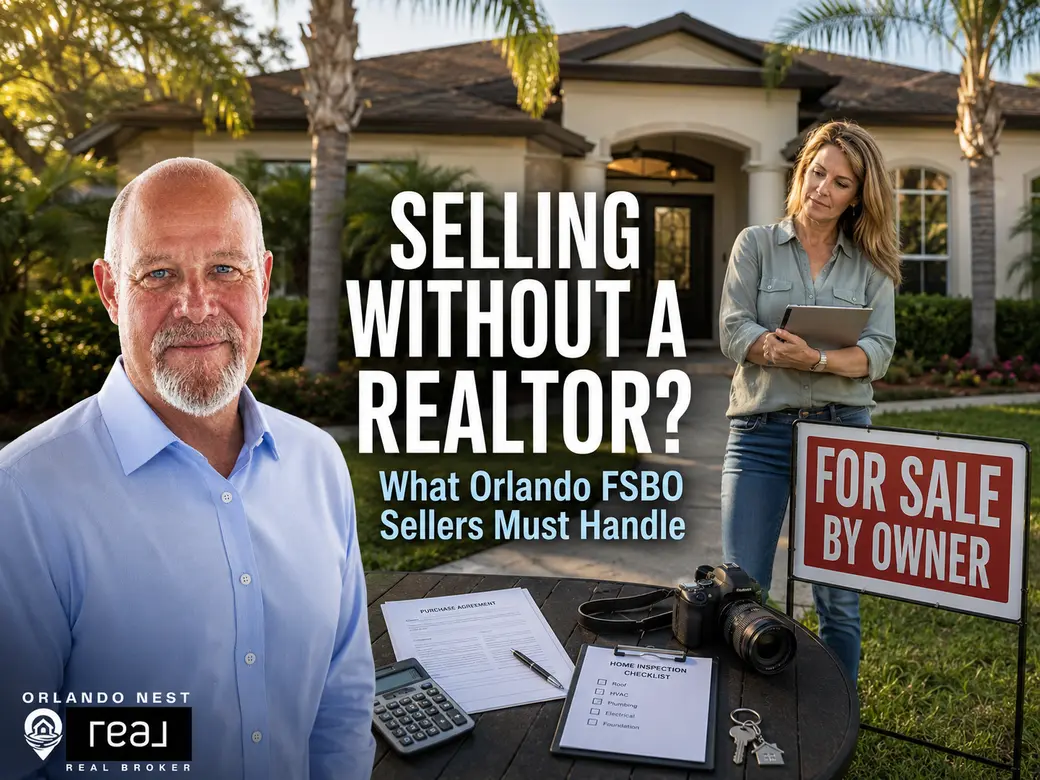
You can legally sell your Orlando house without a Realtor. A for-sale-by-owner transaction makes the most sense when you already know the buyer, understand the property’s value and can confidently manage disclosures, contracts, negotiations, inspections, title work and closing.
Quick Summary
The better question is not whether you are allowed to sell without an agent. It is whether handling the sale yourself will improve your final net proceeds without creating unnecessary risk. FSBO can work well in a simple direct sale, but you are assuming responsibility for the pricing, marketing, paperwork, deadlines and negotiations normally coordinated by a listing agent.
What Does FSBO Mean?
FSBO stands for “for sale by owner.” It means the homeowner offers the property for sale without hiring a listing broker to represent the seller.
It does not mean that the transaction operates outside Florida real estate law. A FSBO seller still needs to manage the same basic transaction:
- Establish an asking price
- Prepare and market the property
- Respond to inquiries and schedule showings
- Verify prospective buyers
- Complete required disclosures
- Evaluate and negotiate offers
- Manage inspections, appraisals and financing issues
- Coordinate title work, closing documents and possession
You are not eliminating the work. You are deciding to perform or coordinate it yourself.
When Selling Without a Realtor Can Make Sense
You already have a buyer
You may be selling to a family member, tenant, neighbor or investor who approached you directly. According to the National Association of Realtors, 60% of FSBO sellers in its 2025 survey already knew the buyer.
That matters because finding the buyer is usually the largest marketing challenge. Even in a direct sale, both parties should still use properly prepared documents and obtain appropriate legal, title, tax and inspection advice. Familiarity is not a substitute for paperwork. Thanksgiving dinner gets awkward enough without an undisclosed roof leak entering the conversation.
You understand the property’s market value
A seller who has closely followed comparable sales may be able to establish a reasonable price. The challenge is separating market evidence from personal attachment. Buyers do not pay extra because you personally selected the backsplash, survived three weekends installing it and still have emotional scars from the grout.
A credible pricing analysis should examine:
- Recent closed sales
- Competing active listings
- Pending sales when reliable information is available
- Property condition and renovation quality
- Lot, view and location differences
- Insurance-related features
- Seller concessions
- Current buyer demand
An automated home-value estimate can be a starting point, but it is not a complete pricing strategy. For more context, read how to price an Orlando home correctly .
You have transaction experience
Someone who has bought and sold several properties, worked in real estate, invested in homes or regularly reviewed contracts may be comfortable coordinating the process. That does not mean every experienced seller should go it alone. It means the learning curve may be smaller.
You have enough time and availability
FSBO sellers need to respond quickly to calls, messages, showing requests, questions and offers. That can become difficult when buyers want to tour at 2:00 on a Tuesday afternoon or submit an offer with a deadline while you are at work. Real estate has an impressive ability to become urgent precisely when you planned to do something else.
What Orlando FSBO Sellers Must Handle
1. Price the property correctly
Overpricing is one of the most expensive FSBO mistakes because it can cost the property its strongest period of buyer attention.
A price that is too high may lead to:
- Fewer showings
- Longer market time
- Repeated price reductions
- Buyer suspicion
- Appraisal problems
- Increased carrying costs
Underpricing creates the opposite risk: selling quickly but leaving more money behind than the seller hoped to save. The goal is to identify the price range most likely to produce the best combination of exposure, negotiating leverage and net proceeds.
2. Prepare the home for sale
Preparation should be based on likely return, not HGTV-induced panic. Common priorities include:
- Correcting visible deferred maintenance
- Addressing safety concerns
- Improving lighting
- Reducing clutter and deep cleaning
- Improving landscaping and entry appearance
- Gathering permits and repair records
- Reviewing insurability concerns
Some improvements help a home sell. Others simply provide the next owner with an expensive renovation completed according to your taste.
3. Create the marketing package
A FSBO listing needs more than a yard sign and a phone number.
- Professional-quality photographs
- Accurate room and property descriptions
- Reliable living-area information
- Feature and improvement details
- Showing instructions
- Property-disclosure documents
- Fair-housing-compliant marketing
- A plan for screening inquiries
A direct owner listing on a consumer portal is not the same as broad exposure through the local multiple listing service and brokerage ecosystem. A flat-fee MLS service can expand exposure, but the seller should determine exactly what is included beyond MLS entry.
4. Protect your safety and privacy
FSBO marketing publishes the owner’s contact information and invites strangers into the property. Create a showing protocol before the first inquiry:
- Verify identities before appointments
- Avoid showing alone when possible
- Secure medications, documents, firearms and valuables
- Do not discuss schedules or travel plans
- Keep financial information private
- Require proof of funds or lender qualification before serious negotiations
Reality Check
A person asking to see the home is not automatically a qualified buyer. Sometimes they are not even particularly interested in buying a home. Curiosity is abundant and, regrettably, not legal tender.
5. Comply with Florida disclosure obligations
Florida sellers should disclose known facts that materially affect the property’s value when those facts are not readily observable to the buyer. Potential disclosure subjects may include:
- Roof leaks or prior water intrusion
- Plumbing or electrical defects
- Foundation or structural concerns
- Unpermitted additions
- Mold or moisture problems
- Sinkhole activity
- Insurance claims
- Boundary or access disputes
- Association disputes or assessments
- Termite or wood-destroying-organism history
- Flooding
- Other known material defects
Florida Flood Disclosure
Florida requires a specific residential flood disclosure at or before the sales contract is executed. It asks about known flooding, flood-related insurance claims and flood assistance received by the seller.
A disclosure form is not a license to guess, minimize or omit. When a condition is complicated, a Florida real estate attorney can help determine what should be disclosed and how it should be described.
Condo sellers may have additional document-delivery and disclosure obligations. Homeowners’ association properties can also involve association disclosures, estoppel information and approval requirements.
6. Evaluate buyers before accepting an offer
The highest offer is not always the strongest offer. Review:
- Financing type and preapproval quality
- Proof of funds and down payment
- Earnest money
- Financing and appraisal contingencies
- Inspection period and repair terms
- Seller concessions
- Closing date
- Sale-of-buyer-property contingency
- Assignment language
- Possession and default provisions
An offer is a package of price, risk, timing and probability. A slightly lower offer with stronger financing, fewer fragile contingencies and a cleaner timeline may produce the better result.
7. Use an appropriate Florida sales contract
Online templates can create a false sense of security. The danger is often not what appears in the contract; it is what was omitted, selected incorrectly or misunderstood.
The contract should clearly address:
- Parties and property
- Purchase price and deposits
- Financing and appraisal
- Closing date
- Title and survey
- Inspections and repairs
- Association matters
- Personal property
- Closing expenses and prorations
- Risk of loss and default
- Disclosures and possession
A real estate attorney can prepare or review the agreement and provide legal advice. A title company can coordinate title and settlement functions, but sellers should not assume every title professional represents their individual legal interests.
What Does It Cost to Sell a House Without a Realtor?
FSBO can eliminate the listing-broker fee, but it does not eliminate every cost associated with selling.
- Photography, cleaning and staging
- Repairs
- Flat-fee MLS services
- Attorney fees
- Title and closing services
- Survey or association charges
- Documentary stamp tax
- Buyer-requested concessions
- Buyer-broker compensation, when negotiated
- Mortgage payoff and lien-resolution expenses
- Property-tax and association prorations
- Moving and carrying costs
Florida documentary stamp tax on a deed is generally $0.70 for each $100, or portion of $100, of consideration outside Miami-Dade County.
Example
On a $500,000 sale, documentary stamp tax would generally be $3,500: $500,000 ÷ $100 × $0.70 = $3,500.
The contract determines which party is responsible for many expenses. Local custom can influence negotiations, but custom is not the same as a legal requirement. See a broader breakdown of Florida seller closing costs .
Buyer-agent compensation is negotiable
A FSBO seller may receive an offer from a buyer represented by a real estate broker. The seller is not automatically required to pay that broker a predetermined percentage. Compensation can be proposed and negotiated as part of the transaction.
Evaluate any compensation request alongside the offer’s price, concessions and overall net proceeds. It affects the bottom line and should be reviewed as part of the entire package.
Do FSBO Homes Sell for Less?
National statistics show a difference between FSBO and agent-assisted median sale prices, but those numbers need context.
The National Association of Realtors reported a 2025 national median sale price of $360,000 for FSBO transactions compared with $425,000 for agent-assisted transactions. It also noted that FSBO properties may differ in location, property type and transaction circumstances. Many FSBO sellers already know their buyer.
That means the price difference does not prove that hiring an agent automatically adds a fixed amount to a home’s value.
Compare Net, Not Just Commission
Expected sale price minus preparation, marketing, concessions, professional fees, carrying costs and transaction risk equals estimated net proceeds.
FSBO Versus Hiring a Listing Agent
| Decision factor | FSBO may fit when | An agent may add more value when |
|---|---|---|
| Buyer access | You already know the buyer | You need broad market exposure |
| Pricing | Comparable sales are clear | The property is unusual or difficult to price |
| Time | You can manage inquiries and showings | Your schedule limits availability |
| Negotiation | You are experienced and objective | The transaction may become emotional or complicated |
| Property condition | The home is straightforward | Repairs, insurance or permits affect marketability |
| Offers | You understand financing and contingencies | You need help comparing price with risk |
| Legal coordination | You have an attorney and title plan | You need a coordinated transaction team |
| Privacy | You accept direct public contact | You want inquiries and access screened |
| Marketing | You can manage professional exposure | You need photography, MLS strategy and targeted promotion |
A Practical Orlando FSBO Checklist
- Confirm legal ownership and signing authority.
- Review mortgages, liens, probate, divorce, trust or estate issues.
- Gather permits, warranties, repair records and association documents.
- Obtain a property-specific pricing analysis.
- Calculate estimated proceeds at several sale prices.
- Decide what repairs or preparation make financial sense.
- Create professional photographs and accurate marketing.
- Select a direct-sale, flat-fee MLS or full-market exposure strategy.
- Establish safety and showing procedures.
- Prepare property and flood disclosures.
- Select a Florida real estate attorney or title professional.
- Create a process for verifying buyers.
- Review every offer as a complete financial and risk package.
- Track contractual deadlines after acceptance.
- Confirm title, payoff, association and closing requirements early.
Frequently Asked Questions
Can I legally sell my Orlando home without a Realtor?
Yes. Florida homeowners can sell their own property without hiring a real estate broker. The seller remains responsible for disclosures, contract terms, negotiations and coordination of the closing.
Do I need a real estate attorney for an Orlando FSBO sale?
Florida does not universally require an attorney to close a residential sale. However, an attorney can provide legal advice, prepare or review the contract and address title or ownership complications.
Can I list an Orlando FSBO property on the MLS?
An owner generally needs to work through an MLS participant, such as a flat-fee listing broker, to place the property in the MLS. Services vary, so review what assistance is included beyond the listing entry.
Must I pay the buyer’s real estate agent?
No fixed buyer-broker fee is automatically required. A buyer may include a compensation request or seller concession in an offer, and the seller can accept, reject or negotiate it as part of the transaction.
What disclosures does a Florida FSBO seller need to provide?
Florida sellers should disclose known material property defects that are not readily observable. Residential sellers must also provide the required flood-risk disclosure at or before the sales contract is executed. Condominiums and association properties may involve additional documents.
Who handles closing in an Orlando FSBO transaction?
Most Orlando-area transactions use a title company or Florida real estate attorney to coordinate title work, escrow, settlement documents and closing. Ask which services are included and whether the professional represents either party’s individual legal interests.
Is FSBO cheaper than hiring an agent?
It can be, particularly when the seller already has a qualified buyer and the transaction is simple. Compare final net proceeds after marketing, concessions, professional fees, carrying costs and risk—not commission alone.
Make the Decision With Real Numbers
You do not need a sales pitch disguised as an FSBO consultation. You need a realistic estimate of value, likely expenses, probable buyer response and what you would be responsible for handling yourself.
Ted Moseley helps Orlando and Central Florida homeowners compare their options with radical honesty—including telling them when a direct or FSBO sale may genuinely make sense.
Get a Straight Answer
Request a confidential home-selling strategy review and compare your likely FSBO and full-market options before making the decision.
Request a Selling Strategy Review
Prefer to talk? Call 321-321-2372.
This article provides general real estate information and is not legal, tax or accounting advice. Consult the appropriate licensed professional regarding your specific transaction.
Categories
Recent Posts




STAY UP TO DATE WITH THE MARKET